Differences Between Shirakawa-go and Gokayama
Gassho style (gassho-zukuri) houses are a form of architecture found only in a very limited area along the Sho River in the Japanese mountains. Even within that narrow range, there are differences between Shirakawa-go and Gokayama in roof shape and thatching methods, entrance location, and floor layout. This page will highlight those differences.
“Tsuma-iri” or “Hira-iri”
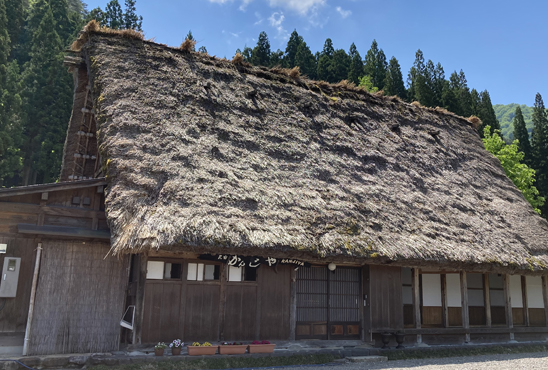
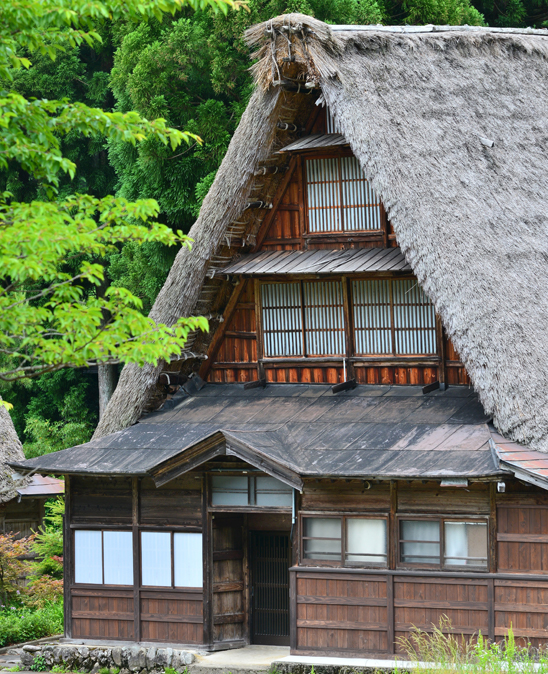
“Tsuma-iri” refers to houses with the entrance on the gable end, while “hira-iri” refers to houses with the entrance on the longer side of the building. In Gokayama, tsuma-iri is more common, while in Shirakawa-go, hira-iri predominates. That said, there are villages in Gokayama, such as Toga Village, where hira-iri is the norm, and in Shirakawa-go, you can occasionally find tsuma-iri houses as well.
It is not entirely clear why such differences arose, but factors thought to be involved include the narrower dirt-floor spaces in Shirakawa-go compared with the wider ones in Gokayama, the relationship between buildings and roads, and the regularity of building arrangements in each settlement.
Differences in Floor Plans
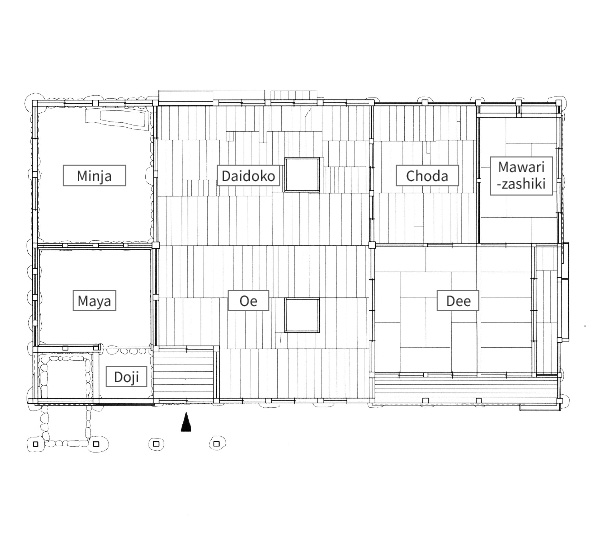
The composition of rooms does not differ greatly between Shirakawa-go and Gokayama. The floor plans of gassho style houses include both the “three-room wide-plan type” and the “four-room wide-plan type,” and in larger houses, an additional two rooms are added to form a six-room layout. In the basic floor plan, for the hira-iri type houses seen in Shirakawa-go, the ridge line divides the house into a front and back. On the lower side of the front is the maya, where draft horses were kept; behind it is the minja (called niwa in Gokayama), which functioned as a working space. Next to the maya on the upper side of the front is the oe (called dee in Gokayama), a living room and guest room; behind it is the daidoko (called oe in Gokayama), with a hearth for cooking. Further along the front upper side is the dei (called dee or omae in Gokayama), a tatami room with a family altar, and behind it is the choda, used as a bedroom. On the farthest upper side front is the household’s Buddhist altar. If there is no partition between the oe and the daidoko, the house is of the three-room wide-plan type; if partitioned, it is the four-room type. In larger houses, an additional reception room (oku-no-dei) is placed beyond the dei, with a study room (mawari-zashiki, called hikae-no-ma in Gokayama) behind it. The front side of the house is thus lined with reception-use rooms, while the rear side contains rooms for daily living, with the front naturally facing the main road. In the southern area of Shirakawa Village, a distinctive feature is a hallway called a shashi that runs from the entrance to the minja.
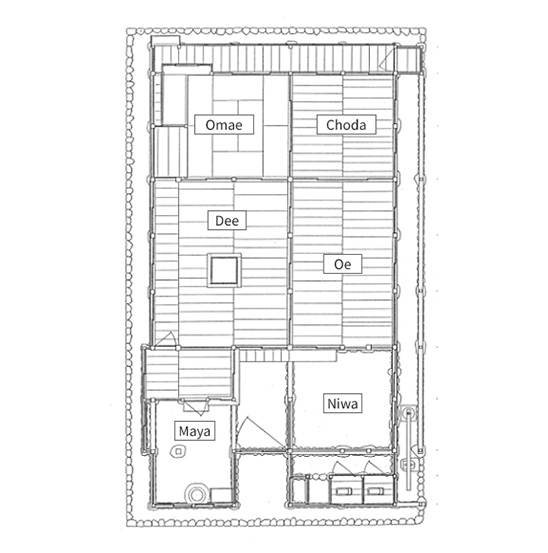
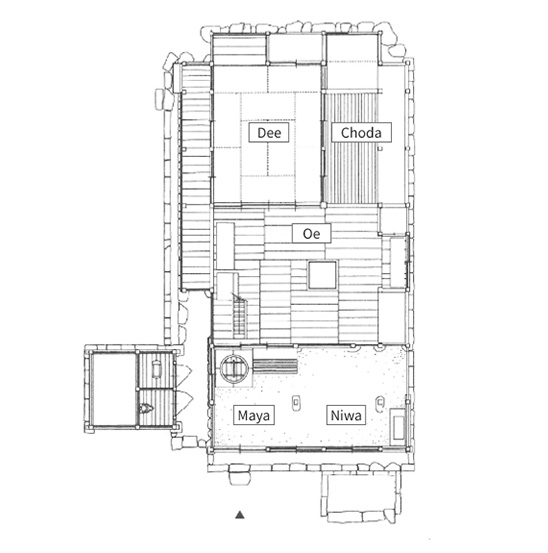
In the case of tsuma-iri houses in Gokayama, the entrance is placed on the maya side, with the adjoining space used as the working area called niwa. Depending on whether the niwa is to the right or left when facing the entrance, houses are classified as “right-katte” or “left-katte.” The arrangement along the maya side follows a vertical sequence of maya–dee–omae–Buddhist altar, while the niwa side has niwa–oe–choda, which is the same configuration as in Shirakawa-go. If the entrance faces the street, the brighter side is used for the maya–dee–omae. In Gokayama, where handmade washi paper production was common, the niwa was used as a papermaking space, so it generally remained an earthen floor rather than being covered with planks, and it was often connected directly to the maya. By contrast, in Shirakawa-go, what Gokayama calls niwa is referred to as usunawa or minja, and it is often floored and used as a workroom, resulting in smaller earthen floor areas overall.
Roof Shapes
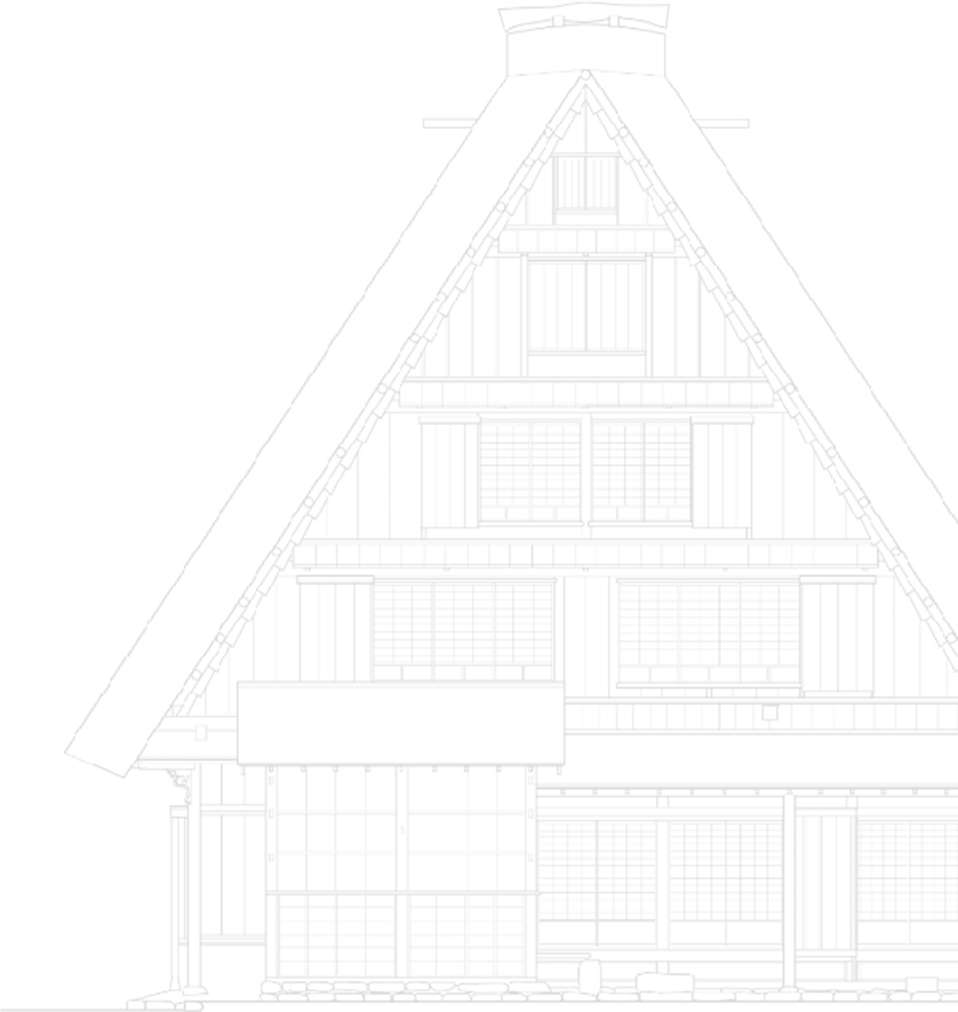
Looking at the roof forms, the gassho style houses of Shirakawa-go have perfectly gabled roofs. By contrast, those of Gokayama appear at first glance to have hip-and-gable roofs. This is because the lean-to roofs projecting from the gable ends are also thatched, and the thatch continues seamlessly into the main roof, creating the appearance of a large gable with prominent bargeboards. Structurally, however, they are still gabled roofs.
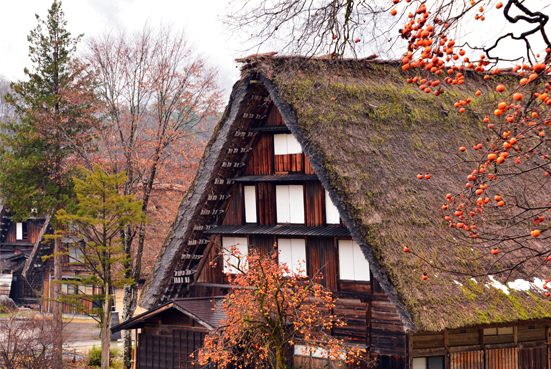
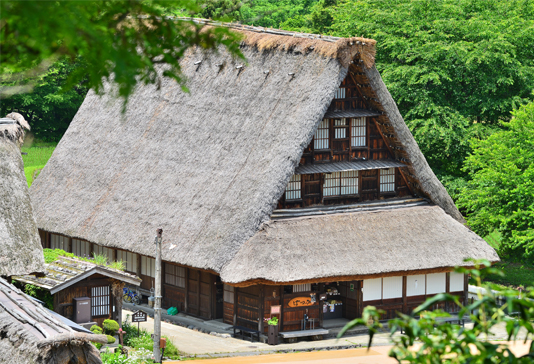
Thatched Roofs by Whole Half-Roof in Shirakawa-go, by Divided Sections in Gokayama
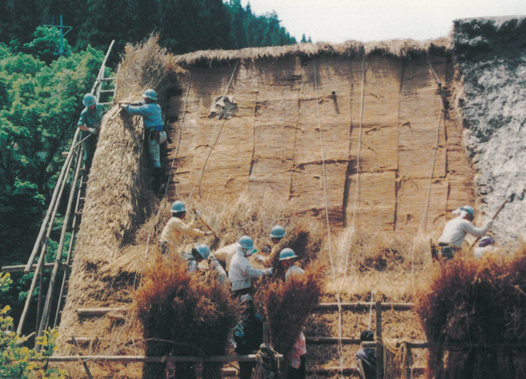
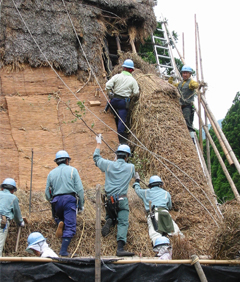
The greatest difference between Shirakawa-go and Gokayama lies in how their thatched roofs are laid. Specifically, the scope and frequency of rethatching differ. The gassho style roofs were thatched through the villagers’ mutual-aid system known as yui. In Shirakawa-go, more than 100 people would gather to thatch an entire half of a roof in one go, whereas in Gokayama, a small group of people would divide a half-roof into sections and thatch them separately. This is often attributed to differences in settlement size or the amount of thatch available from local fields, but in Shirakawa-go even small villages of 7–8 households would not divide the work. Instead, they called upon neighboring settlements to gather both manpower and thatch, so that the half-roof could be rethatched all at once. By contrast, in Gokayama the area to be rethatched was adjusted to match the quantity of thatch the villagers could prepare themselves, so smaller groups would divide one half of the roof into 2–4 sections and thatch them separately.
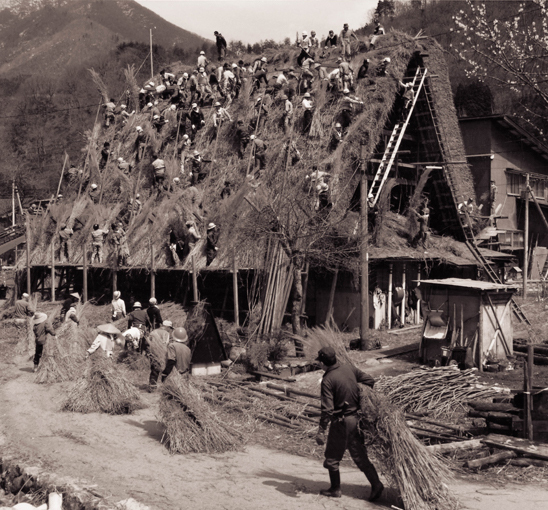
Differences are also seen in the rethatching cycle. In Shirakawa-go, once rethatched, a roof was expected to last 40 to 60 years, and in some cases as long as 80 years. This is considered one of the longest rethatching intervals among Japan’s thatched farmhouses. In contrast, in Gokayama, a half-roof would be divided into thirds (effectively six divisions in total), and each divided portion would be rethatched on a very short cycle of about 10 years—the shortest rethatching cycle in Japan. The reason for this short cycle in Gokayama is said to be the active use of the old thatch removed during rethatching as fertilizer for mulberry fields in sericulture and for other farmland. These differences in cycle and method created distinct roofing techniques in each region. In Shirakawa-go, to extend durability, roofs were thatched thickly, to about 80 cm. In Gokayama, since rethatching occurred frequently and had to match the thickness of the remaining old roof, the thickness was kept to 60–70 cm. Especially in Gokayama, because roofs were thatched in divided sections, a unique technique developed, called hasami-gaya, to handle the joints between old and new roof sections, something not seen in Shirakawa-go.
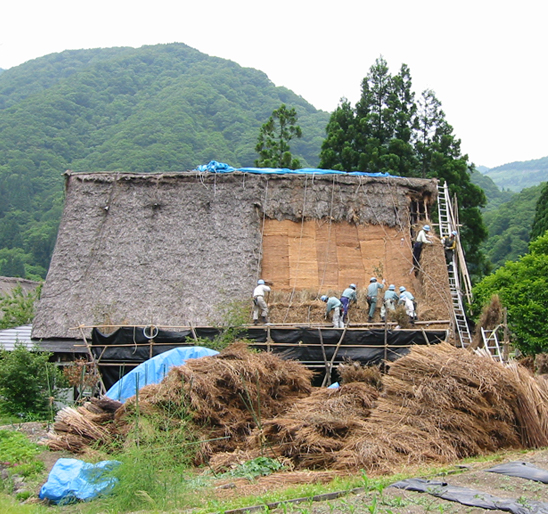
―― Record of a Half-Roof Being Thatched All at Once in Shirakawa-go
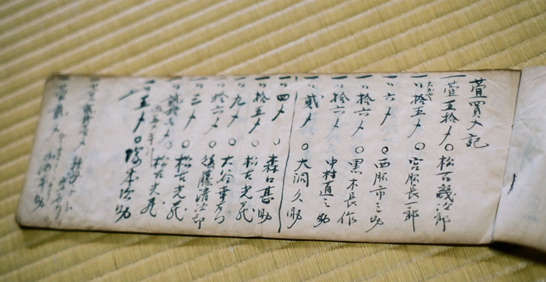
In Miboro, a small settlement of only four households in southern Shirakawa Village where the Important Cultural Property, The Former Toyama Residence is located, records remain in the “Warehouse Roof-Thatching Account Book” (1792). These show that helpers came from surrounding villages such as Hirase and Nagase, and that even an auxiliary building was rethatched with the help of a total of 47 workers. From this, we can see that in Miboro, by at least the late Edo period, roofs were rethatched all at once.
Additionally, in the village of Omaki, containing about 12 households and located between Miboro and Ogimachi, the former Ota Residence preserves the “Rear Roof Rethatching Diary” (1946). This records that for the rethatching of a dwelling, helpers came from four neighboring settlements, including Hokiwaki (6 households), Nodani (3 households), Okubo (2 households), and Magari (8 households).
In this way, Shirakawa-go rethatched half-roofs at once with large groups of people, keeping detailed records known as yui-cho (“mutual aid ledgers”), which listed the number of helpers and bundles of thatch borrowed. This allowed each household to track which ones they owed reciprocal labor.
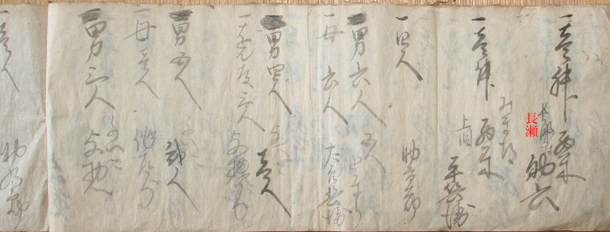
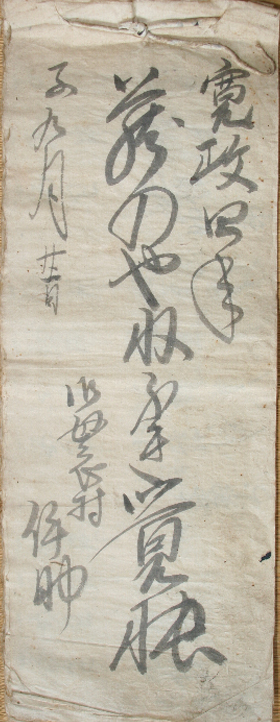
1792
―― Roof-Thatching Cycle in Ainokura Village
Today in Gokayama, rethatching is mostly handled by hired craftsmen, and dividing a half-roof into sections is rarely seen. But until about 40 years ago, households still rethatched their own roofs.
At the I Residence in Ainokura, the family could prepare 400 bundles of thatch in a year. In two years, that meant 800 bundles, enough to cover one-fourth of a half-roof. Since both front and back were rethatched this way, the roof was effectively divided into eight sections. It took 16 years to complete rethatching the entire roof, and by then, the earliest section would already need to be replaced again—meaning the work was repeated continuously on a two-year cycle.
Ainokura had 27 households at the time, and in the Meiji period as many as 47, making it comparable in scale to Ogimachi Village. In theory, the village size was sufficient to thatch a whole half-roof at once, as in Ogimachi. However, in Gokayama the scope of rethatching was limited by the amount of thatch that could be gathered independently. As a result, rethatching was generally carried out by each household individually, with help only occasionally borrowed from neighboring houses or relatives in nearby villages. For this reason, records like the yui-cho of Shirakawa-go are rarely found in Gokayama.
―― Thatch Storage Methods Seen in the Yui-cho
The Warehouse Roof-Thatching Account Book (1792) preserved at the Toyama Residence is the oldest known yui-cho in Shirakawa Village, dating back about 230 years. A yui-cho recorded the names of those who came to help with roof rethatching. Depending on the time period and the household, the records varied, sometimes also listing materials such as thatch and rope, or food items such as tofu, sake, and fried dishes, indicating that both materials and food were lent and borrowed.
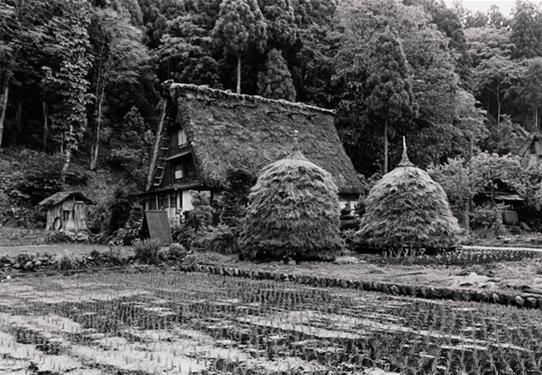
Of particular importance was the practice of “lending” thatch, which was crucial for storage management. Thatch was harvested between late October and the first snowfall in November. After cutting, it was stacked in the fields: in Shirakawa-go into bundles called nyu, and in Gokayama into nigu, where it was stored outdoors until the spring rethatching season. In Shirakawa-go, since at least one house would undergo rethatching each spring, households would actively lend thatch. This practice of “lending” was considered a form of storage: if thatch was left in outdoor stacks year after year, it would deteriorate, but by lending it out annually, households ensured that when it was returned, they received fresh thatch for their own roof.
In Gokayama, however, the approach was different. Households limited the scope of rethatching to the amount of thatch they could harvest from their own fields, and by rethatching frequently, they shortened the storage cycle. Since the thatch was used soon after harvest, there was little need for long-term storage or lending, and active lending of thatch was uncommon.
Thus, Shirakawa-go, which rethatched large roof sections at once, and Gokayama, which rethatched in smaller portions, each developed rational cycles of thatch use suited to their circumstances.
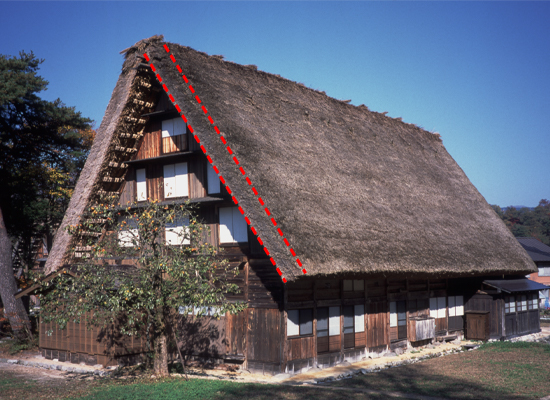
Differences in Bargeboard Shape
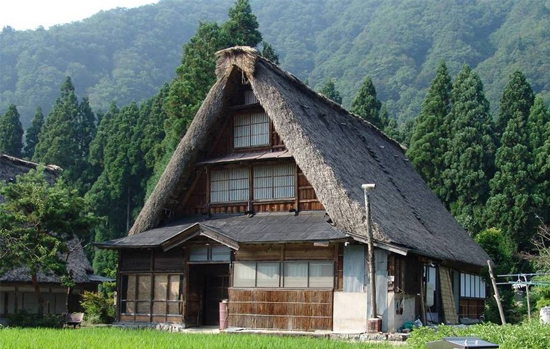
Comparing the roof shapes of Shirakawa-go and Gokayama, Shirakawa-go roofs appear angular, while Gokayama roofs have a more rounded profile. This difference arises from variations in the thatching method at the roof edges, specifically the bargeboards.
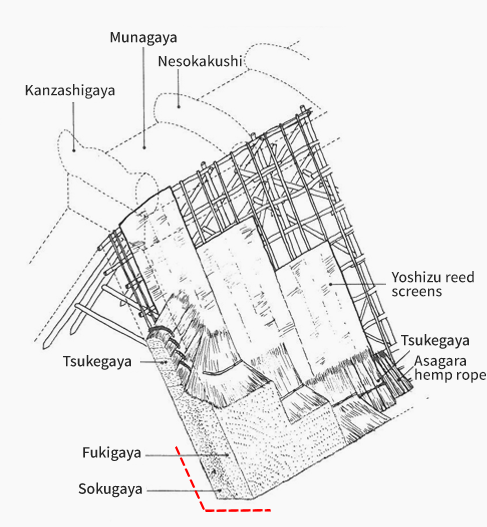
In Shirakawa-go, the lowest thatch at the gable end (called "sokugaya") is laid starting from the root of each bundle, angled at 45 degrees. From there, additional thatch ("tsukegaya") is laid diagonally upward, aligned to that angle. As a result, when viewed from the gable end, the cut roots of the tsukegaya are exposed, and the top edge of the bargeboard is finished at a sharp right angle, giving the overall roof a crisp, angular appearance.
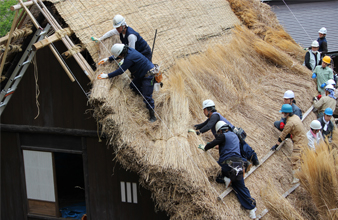
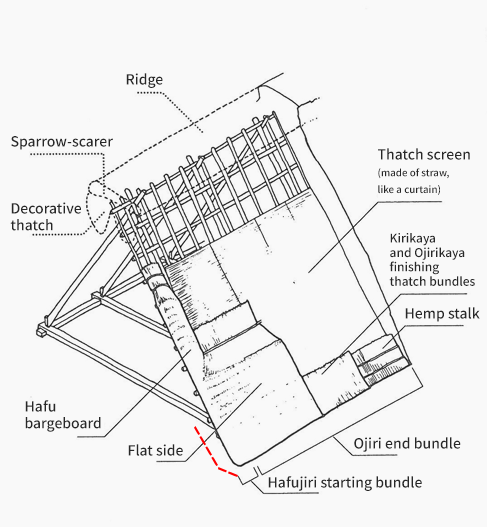
In contrast, in Gokayama the thatch at the bargeboard is laid in a cylindrical form, a method called hafu-yui (“bargeboard binding”). Hafujiri (called sokugaya in Shirakawa-go) is the starting point. The hafujiri is made by wrapping thatch around hemp stalks to form bundles about 70 cm in diameter, which then serve as the standard for thatching thickness. In Shirakawa-go, a guideline string is stretched from ridge to eaves to regulate thickness, but in Gokayama no string is used, since the thickness is determined by the hafujiri. Because the bargeboard is thatched cylindrically in this way, the entire bargeboard takes on a rounded shape, giving the roof a soft, gentle appearance.
Angles of the Eaves
Looking more closely at the eaves: in Shirakawa-go, the underside of the eave-thatch meets the rafters at a right angle. In Gokayama, however, the underside of the eave-thatch has a “throwing slope” of about 110–115 degrees relative to the rafters. This is because in Gokayama, the gable end often has a thatched pent roof, which continues seamlessly from the eave-thatch of the long side. Even houses without such gable pent roofs show the same throwing slope effect, as the technique carried over.