Midorigaike Pond
Near the summit of Mt. Hakusan are numerous explosion craters, some of which hold water and have become ponds. Midorigaike is the largest of the seven ponds scattered across Mt. Hakusan. Situated at an elevation exceeding 2,500 meters and surrounded by bleak volcanic terrain, it nonetheless holds water of a constant blue-green hue. This mysterious coloration is the result of a combination of snowmelt and volcanic geological conditions, captivating the eyes of climbers and, since ancient times, inspiring reverence as a sacred presence.
The Record of Mt. Hakusan (the oldest origin legend of Hakusan Shrine, dating to 1163) contains a description suggestive of a volcanic origin: after two child deities hurled rocks and earth, one place filled with clear water and became “Midori Pond.” This eruption is thought to have occurred in 1042. From a geological perspective, Midorigaike is regarded as the only one among the seven crater lakes to retain traces of a lava dome formed during an eruption.
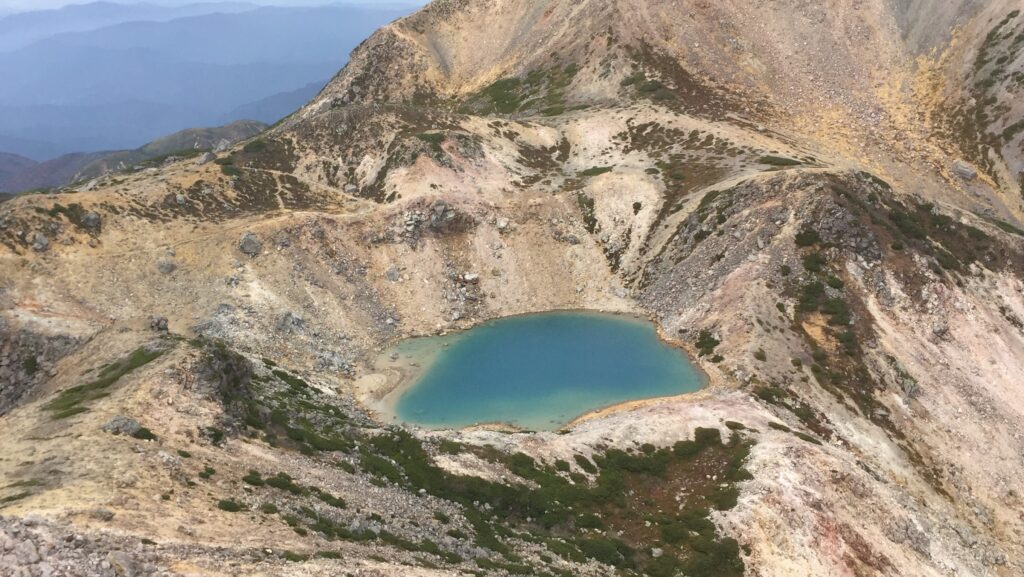
The Record of Mt. Hakusan also records that at the foot of “Tsurugi no Miyama” (Mt. Kengamine) there was a pond called “Midori Pond,” and that drinking its water bestowed extended life and longevity. It further recounts that beside “Oyama” (Mt. Kengamine) stood tamaden (a sacred shrine), and that a Gongen deity emerged from Midori Pond. For these reasons, Midorigaike is considered a site deeply connected to the origins of Hakusan worship.