Structure of Gassho Style Houses
The Framework is Built by Carpenters, the Roof Framing by “Yui”
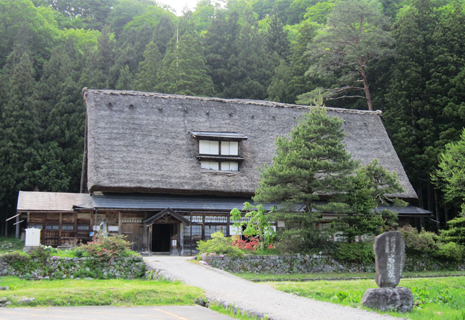
In gassho style houses, the framework and the roof framing are structurally and clearly separated, and this distinction is tied to the construction methods. In other words, in this region, the framework is the work of professional carpenters with specialized skills, while the setting of foundation stones, securing, processing, assembling, and roofing of the roof framing materials are carried out through the traditional mutual aid system known as Yui. Thus, the framework members are carefully finished with planes and assembled using a variety of joinery techniques, whereas the roof framing and roof use logs left in their natural form, roughly finished with an axe or hand axe. Assembly of these parts is done simply by tying them with straw rope or witch hazel (neso). This reveals a clear difference in craftsmanship between the framework and the roof framing.
Since the framework requires hiring carpenters, construction costs are involved, but for the roof framing and roofing, no cost is incurred because the villagers participate through Yui. This clear division between professional work and mutual-aid work is unique to this region and not found elsewhere.
The Framework is Built by Carpenters, the Roof Framing by “Yui”
―― The Activity of the Okubo Master Carpenters
*Click to open PDF
―― The Activity of the Okubo Master Carpenters
The construction of gassho style houses in Shirakawa-go and the Gokayama area is said to have been deeply connected with the group of master carpenters known as the “Okubo Carpenters,” retainers of the Kaga Domain. The Okubo Carpenters were a group who settled in Okubo village in Himi District, on the border of Etchu and Noto, in the early modern period. Summoned by Maeda Toshiie of the Kaga Domain, they served as official temple and shrine carpenters for the domain.
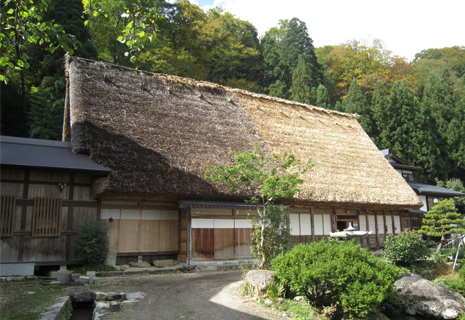
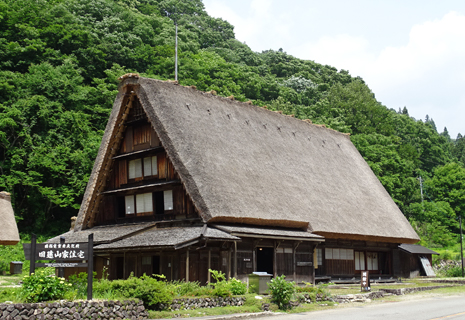
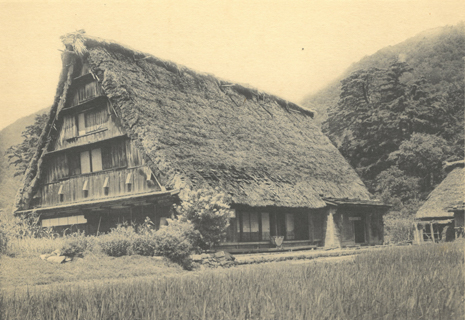
However, after entering the Genroku era, private construction flourished, and the Okubo Carpenters began to take on private building projects during their spare time from domain service. Their activities gradually expanded, reaching not only Etchu, Kaga, and Noto, but also as far as Hida. In Gokayama and even Shirakawa-go, many shrines, temples, and houses built by the Okubo Carpenters still remain, with ridge tags and construction ledgers as evidence. Representative examples include Sumiyoshi Shrine Main Hall in Kaimugura, former Kamitaira Village, Gokayama (built 1719); The Haba Residence in Oze (built 1814); The Important Cultural Property Iwase Residence (renovated 1825); The Important Cultural Property Former Toyama Residence in Shirakawa-go (built 1850), The Important Cultural Property Former Oto Residence (built 1833); and The Former Ota Residence (built 1842).
Structure of the Framework
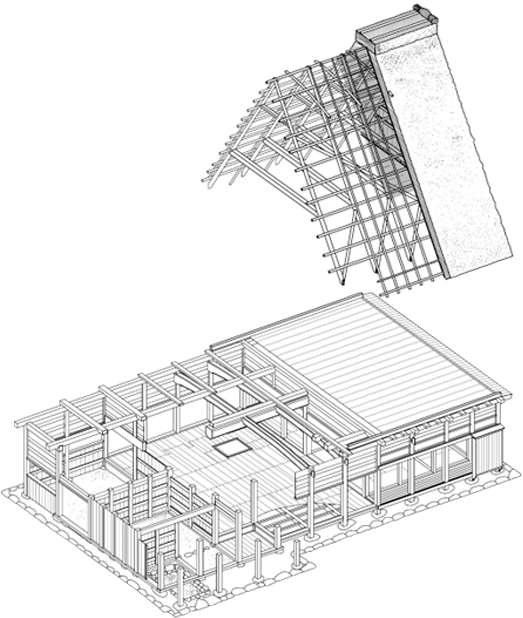
The foundation consists of natural stone foundation blocks, on top of which square pillars are mortised and set at close intervals of one ken (about 1.8 m) or one and a half ken. The tops are reinforced with purlins and beams, and many through-beams and inserted lintels are added in between, making the framework extremely sturdy. As for walls, when an entire side is enclosed, the upper section above the through-beams usually consists of a panel wall with boards fitted into the frame, while the lower section often uses vertical boards nailed to the outside of the through-beams.
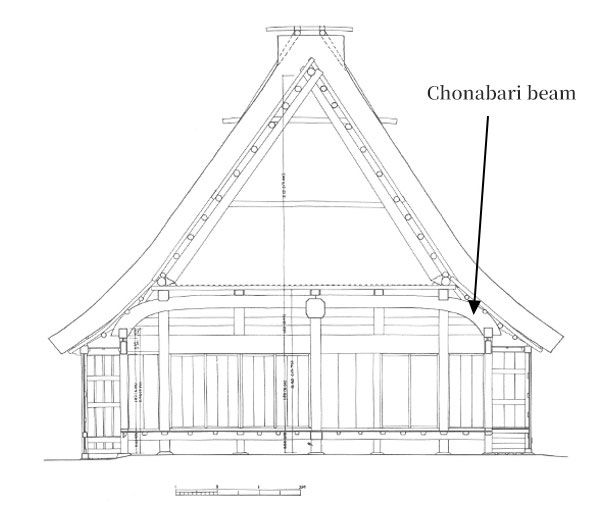
The span of the main building (the length of the thin beam that serves as the lower chord of the rafter frame) is generally three to four ken, but in larger buildings it may exceed six ken. In many cases, half-ken lean-tos are added on one or both sides to extend the span. In such cases, a thin beam is placed along the central span in the direction of the ridge, and between this and the side columns a bent beam made from naturally curved timber called a chonabari is installed. This allows the removal of inner columns and brings the lean-to space into the interior.
Structure of the Framework
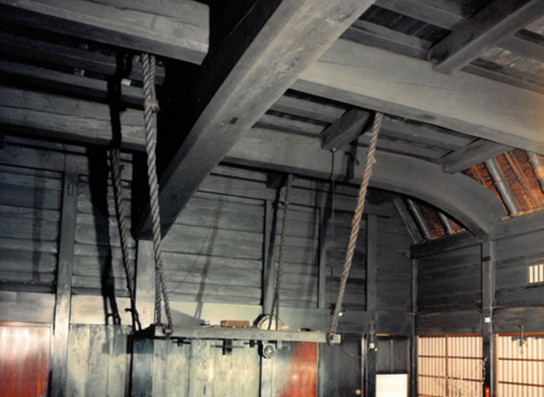
The chonabari beam makes use of trees that have grown curved at the base due to the heavy snow and steep slopes of the region. This represents an effective use of local climate-formed resources, while also providing a structurally excellent solution.
As for features of the structure below the purlins, compared to ordinary farmhouses, the pillars and beams are generally much thicker. Even in later periods, perimeter and partition pillars were erected at intervals of one ken or one and a half ken, with through-beams closely inserted, resulting in an overall solid construction. This was necessary to withstand the large roofs and the heavy snow loads they carried.
Structure of the Roof Framing and Roof
Structure of the Roof Framing and Roof
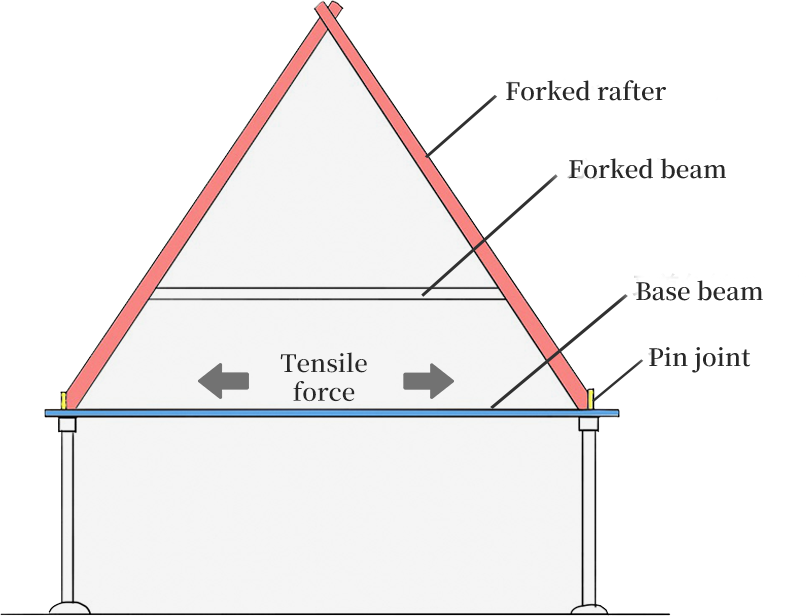
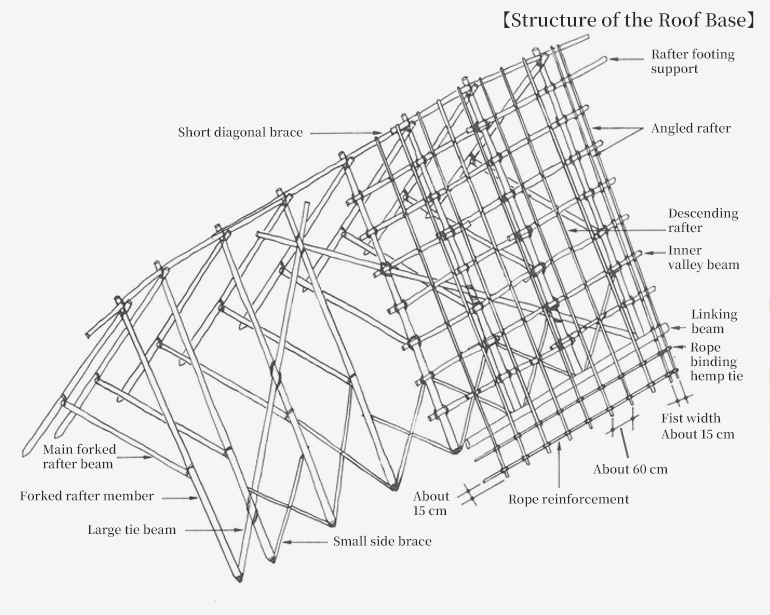
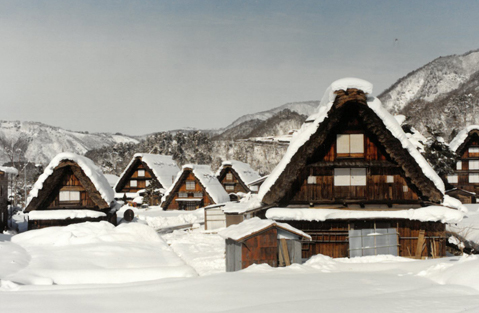
The roof framing is built by placing rafter frames at intervals of one ken (about 1.8 m) on top of horizontally assembled purlins and beams. On each base, one pair of forked rafters is erected. The ends of the rafters are finely trimmed and inserted into holes bored into the ends of the usubari beams. The upper ends of the rafters are joined with a half-lap joint, bound tightly with witch hazel wood, and a ridgepole is laid across the top of the joint. The roof pitch is quite steep, nearly 60 degrees, though older buildings tend to have gentler slopes and newer ones steeper slopes. On top of the fork bases, lattices of wood or bamboo, or sometimes boards, are laid to form flooring, making the roof space usable. Furthermore, the triangular spaces formed by the forked rafters are divided into two or three levels, and in larger houses up to four levels, for advanced utilization. The roof interior was mainly used as work space for sericulture.
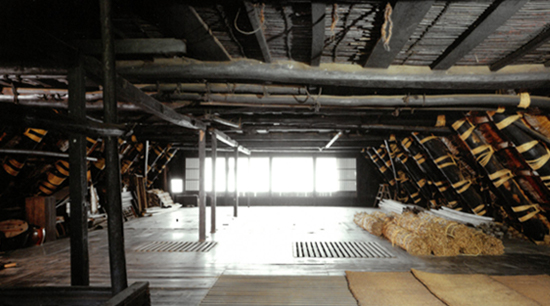
When additional floors are created inside the roof, a horizontal forked beam is inserted into the forked rafters and fixed with wooden pegs. A lattice of slats is then laid across this to form a floor. The gable ends are finished with board walls, but for ventilation and light, windows fitted with paper-covered sliding panels are installed. Above the forked rafters, horizontal logs are laid, rafters are set in place, and reed mats are spread as the base for thatched roofing. To compensate for the structural weakness of the gabled roof design, multiple diagonal braces of various sizes are added either on the inside or outside of the forked rafters in a cross-bracing pattern.
―― A Rational Structural Design Seen in the Joints
The lower ends of the forked rafters are sharpened like the tip of a spindle, which is why they are called “komajiri” (spindle ends). These ends simply rest in sockets cut into the base beams. This creates a contact point similar to a pin joint, which prevents bending forces from the roof and truss from being transmitted down into the main framework. The base beams on which these spindle ends rest are designed solely to resist the outward thrust created when the forked rafters push against them. Because of this, the beams are made quite thin at about 9 cm thick. Looking closely at this construction, we can see that gassho style houses were built with a precise understanding of structural mechanics, making full use of the engineering knowledge available at the time.