The Large Family System in Shirakawa-go
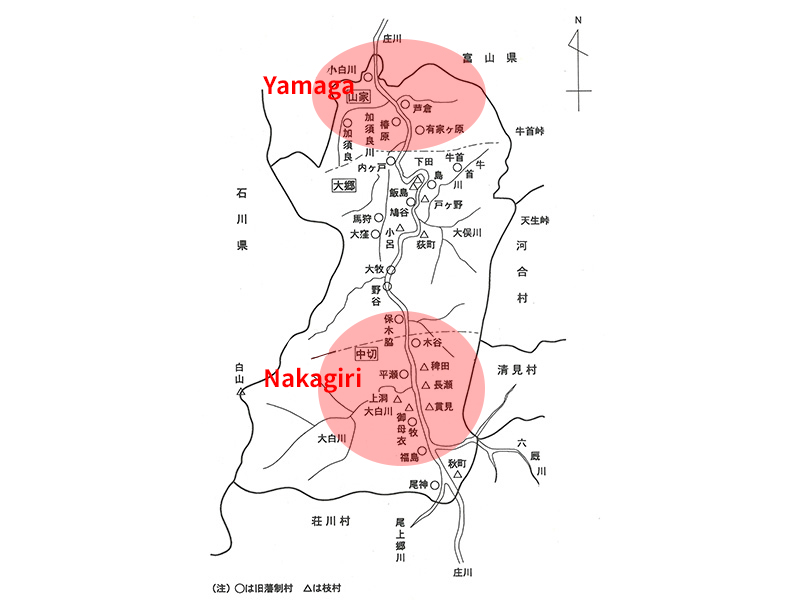
The “large family” system—characterized by a high number of family members living within a single household—was found particularly concentrated in the Nakagiri District in the southern part of Shirakawa Village and the Yamaga District in the north. This characteristic became especially pronounced after the start of the Meiji period. At the Toyama Residence, now designated as an Important Cultural Property, as many as approximately 45 people lived together at its peak (in the 1890s).
The principal factors behind the development of this large family system are thought to be the need to secure labor for sericulture operations, which expanded rapidly from the late early modern period into the Meiji era, and the difficulty of establishing branch households due to land constraints in mountainous village settings.
Characteristics of Large Families in Shirakawa Village
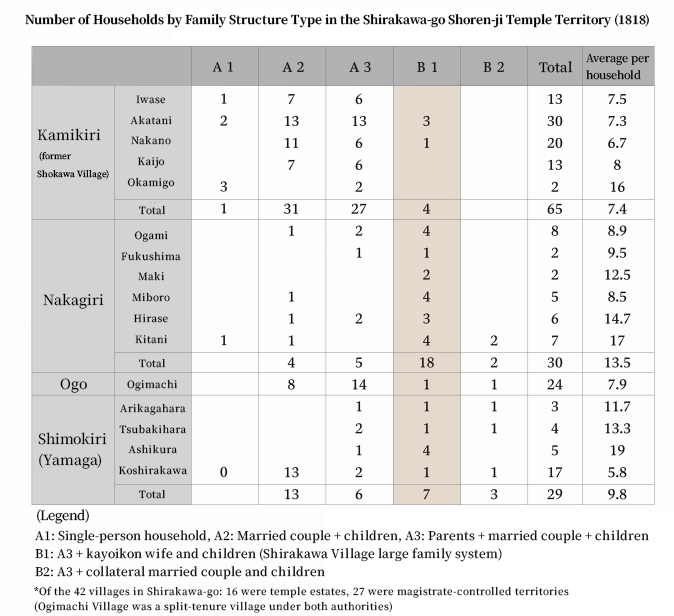
One of the foremost characteristics of large families in Shirakawa Village is that all households within a settlement uniformly took on a large-scale family structure. The table below classifies household sizes by number of residents in each settlement of the Nakagiri District in 1902, where the large family system was observed. According to this data, households in the settlements of Nagase, Miboro, Hirase, and Kitani all consisted of more than 20 family members each. While cases of exceptionally large households existing alongside smaller ones were commonly seen in rural areas of eastern Japan, examples in which every household within a settlement formed a large family were extremely rare on a nationwide scale.
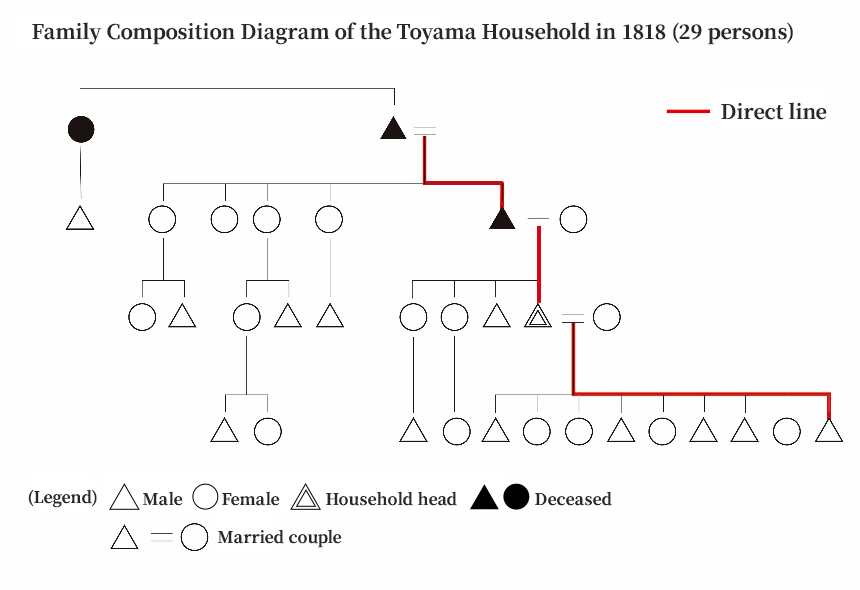
Another distinctive feature can be seen in marriage practices. The heir to the household (the direct line) would continue to live with the family after marriage, whereas other siblings (collateral relatives), commonly referred to as uncles and aunts, remained in their respective natal homes even after marriage, following a system known as kayoikon (commuting marriage). Most children born from these unions were raised in the mother’s natal household. This practice was also widely shared among households within the settlement and represents a highly distinctive feature. It is said that, within the specific region of the Nakagiri District, this large family structure was created and sustained as an institutionalized way of life rooted in local customs and social practices.
Sericulture and Women’s Labor
A defining characteristic of sericulture in Shirakawa Village was that, because arable land was scarce, there was little room to secure dedicated mulberry fields. As a result, most mulberry leaves were obtained from naturally grown mountain mulberry trees. These mulberry trees were scattered across wide areas, requiring considerable labor to gather the leaves, and much of this work was undertaken by women.
In addition, the cocoons that were produced were generally reeled into silk thread at home. In Hida Shirakawa Village, a work by Mieko Ema, who conducted surveys centered on the Kidani settlement beginning around 1936, the following descriptions are given regarding women’s silk reeling at the time:
“From July, after the cocoons were harvested, four or five women would begin reeling together, and it would continue until the autumn equinox. Each person had a daily quota measured in sho, and as the days grew shorter in autumn, they reeled by the light of hyobi oil lamps.”
“A full-fledged woman was required to reel three sho per person. One pot held six go, making five pots in total, but because the reeling method was simple—turning the wheel with one hand—it was extremely demanding. From early morning until night, they reeled by the light of hyobi oil lamps close at hand.”
These accounts clearly show how heavily sericulture depended on women’s labor. As a result, it came to be expected that women who were accustomed to the family trade would remain in their natal households and continue working in the family business as much as possible. This is said to have gradually given rise to the marriage form known as kayoikon (commuting marriage).
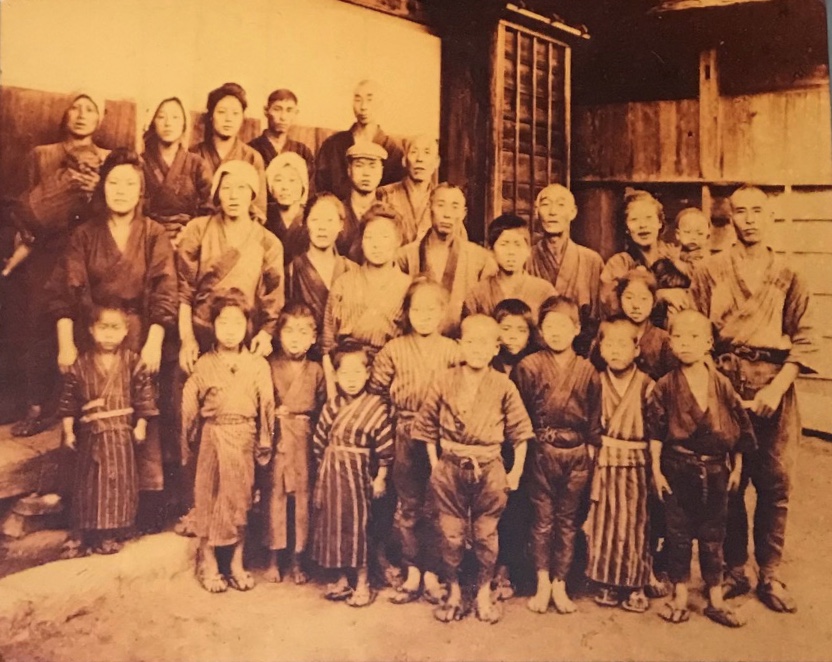
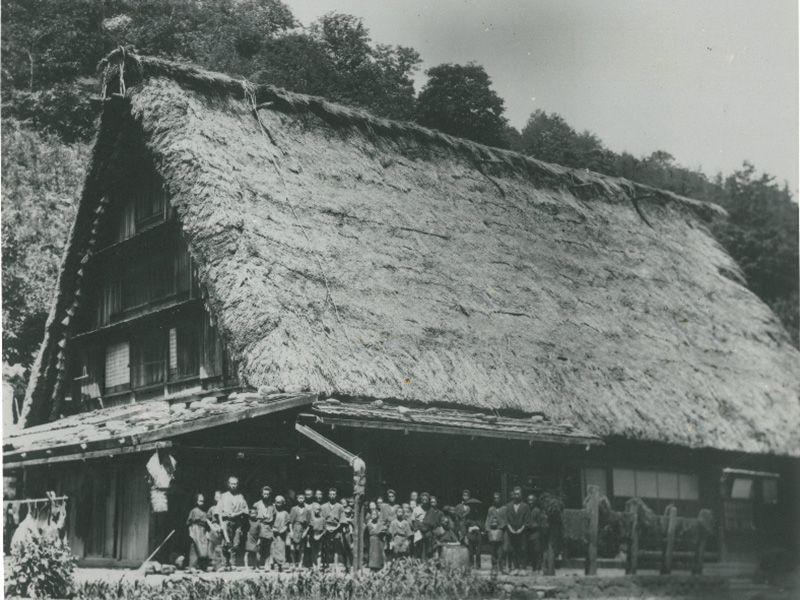
Families around 1912
Not only their own children, but all the children of the household were raised without distinction by all members of the family.
The Living Structure of Large Families as Seen through Shingai Work
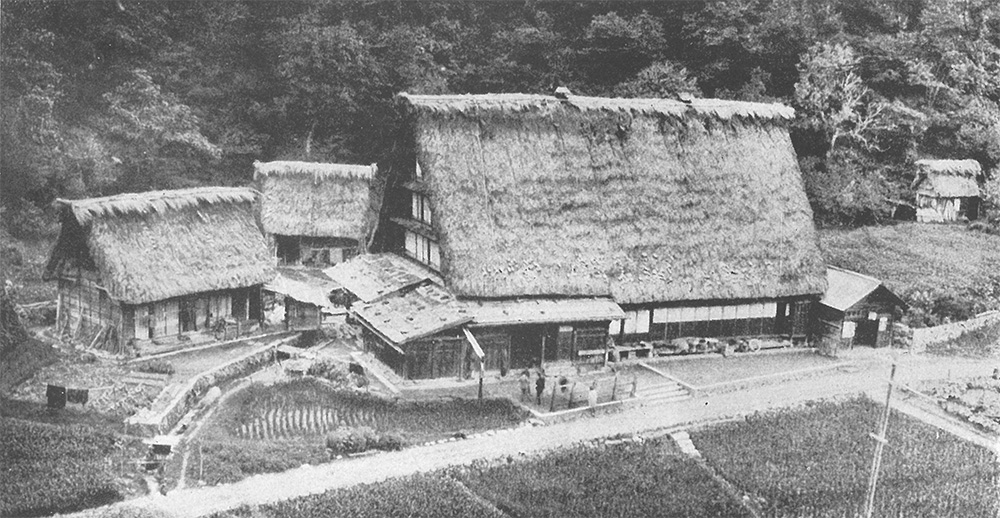
The Toyama household around 1935
The koya on the left side of the main house became the living space for collateral couples on shingai days.
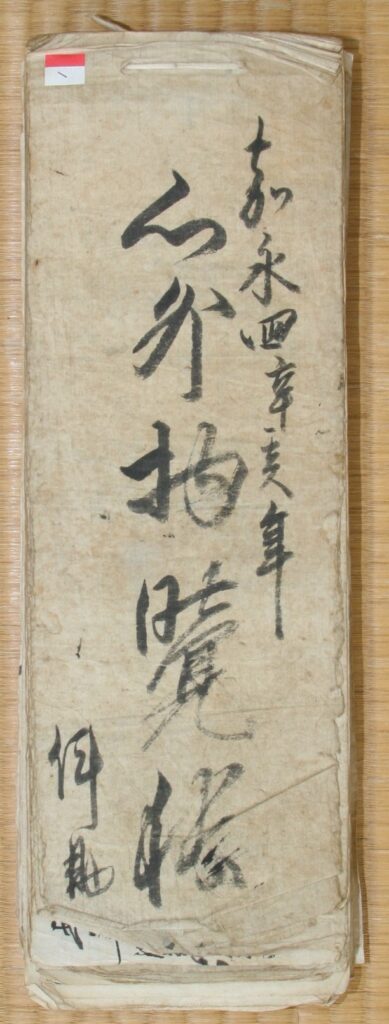
The Record Book of Shingai Goods held by the Toyama family is a ledger that records shingai goods purchased by the household head from family members over a 40-year period, from 1851 to 1891. Shingai goods refer to private products made by family members using shingai days (days off) and similar time. In the Toyama family’s ledger, sales of items such as millet, soybeans, rice, chestnuts, buckwheat, and mulberry leaves are recorded. Nearly all family members—except children and the household head—engaged in this shingai work.
In the Nakagiri District, a clear distinction was made between household-managed production and shingai, private production. On every fifth day, designated as a shingai day, no meals were provided by the household. Instead, people cooked food harvested from their own shingai fields in their own pots. This was known as the “shingai pot,” and they lived a separate, pot-by-pot existence. At the Toyama household, collateral couples used a small building called a koya, located next to the main house, as their living space on shingai days.
From these realities of shingai work, it becomes clear that the “large family” system of Shirakawa Village was neither a remnant of an ancient social system, as earlier researchers once suggested, nor a closed, feudal family structure dominated by patriarchal authority. Rather, while it was based on commodity production through family labor in the management of the household economy, it was also a highly rational living structure in which the private lives of individual family members were respected.
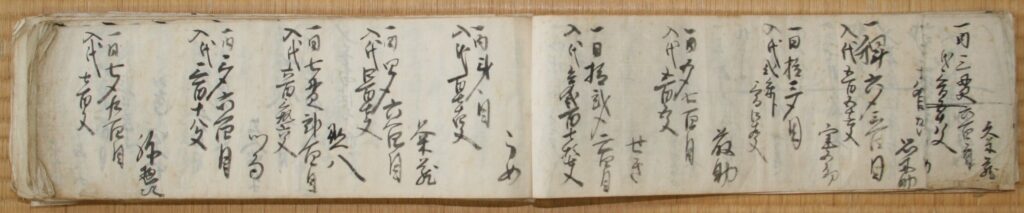
The Record Book of Shingai Goods (1851)
“Money earned through shingai work was used for the small expenses of daily necessities. Men bought sake and tobacco, while women made padded winter kimono and undergarments, and then saved money to cover the costs of pilgrimages to Kyoto. Since women usually had two or three children, much of the money was spent on those expenses.”
— from Mieko Ema, Hida Shirakawa Village
History of Research on the Large Family System
It is often said that what first brought gassho style houses to public attention was the distinctive family structure of Shirakawa-go known as the “large family” system. Many researchers—particularly sociologists and folklorists—visited Shirakawa-go to study this system as a subject of academic inquiry. As a result, gassho style houses came to be widely recognized as the physical framework that supported the daily lives of these large families.
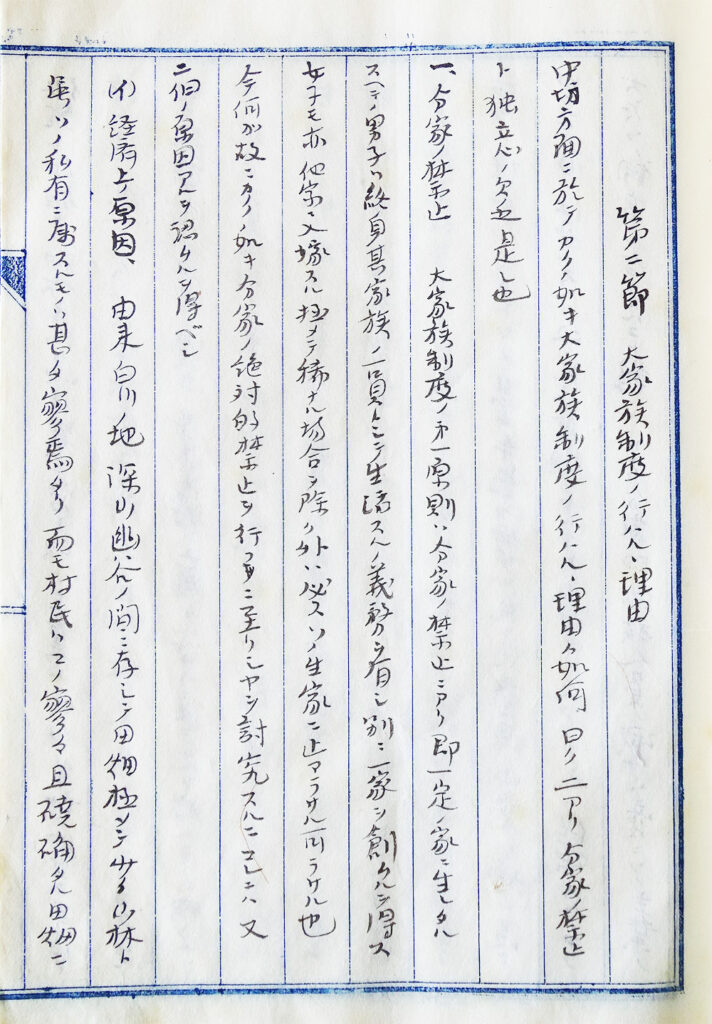
Interest in the “large family” system of Shirakawa Village is said to have begun when Mitsuzo Fujimori of Kyoto University introduced a paper on large families in an academic journal in 1888. Thereafter, Shirakawa Village rapidly attracted public attention, and many researchers and members of the press visited the area, bringing it into the national spotlight. However, much of this early interest did not go beyond a superficial curiosity about an unfamiliar culture. Amid these circumstances, the first researcher to conduct a study based on a scientific research perspective and to present it as an academic paper was Dr. Eijiro Honjo, a scholar renowned for his work in Japanese economic history.
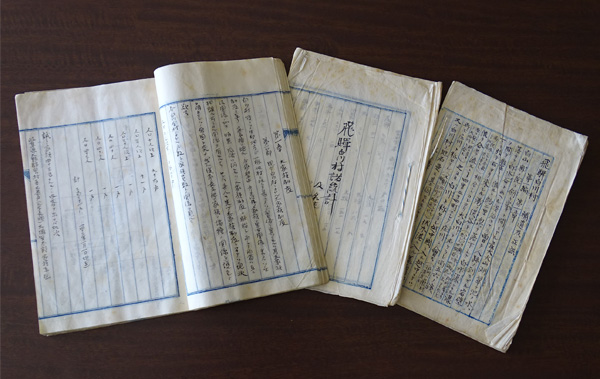
Dr. Honjo’s paper, “The Large Family System of Hida Shirakawa,” published in 1911 in the Kyoto Law Society Journal (Vol. 6, No. 3), was the first academic work to use the term “large family” as a scholarly concept. It presents a wide-ranging and systematic body of research, covering the regional distribution and causes of the large family system, the authority of the household head, various aspects of daily life within large families, and prospects for the future of the system. This paper is regarded as particularly significant because it had a major influence on subsequent studies of the Shirakawa Village large family system by many researchers from the Taisho period through the prewar Showa era.
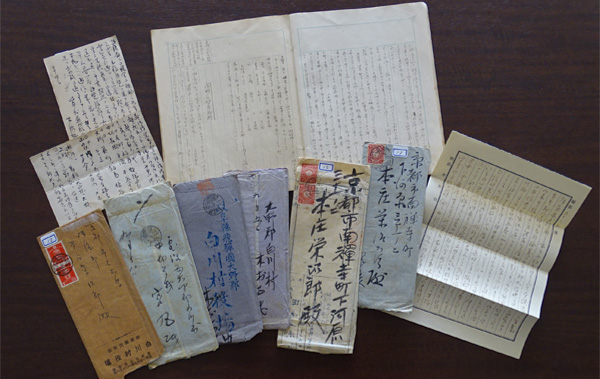
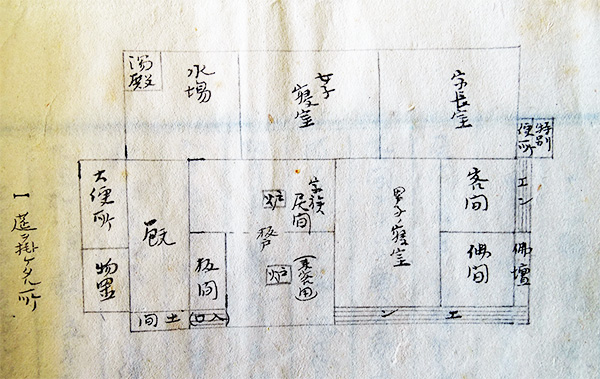
Among the survey materials collected are floor plans of the Toyama Residence from the period and copies of family registers, indicating that Dr. Honjo conducted his field research with the Toyama household as his base.
Researchers of the Large Family System
From the Meiji, Taisho, and Showa periods onward, a wide range of researchers—including those in the social sciences, sociology, folklore studies, anthropology, and history—visited Shirakawa Village. Here, among the many scholars involved, several representative researchers are introduced.
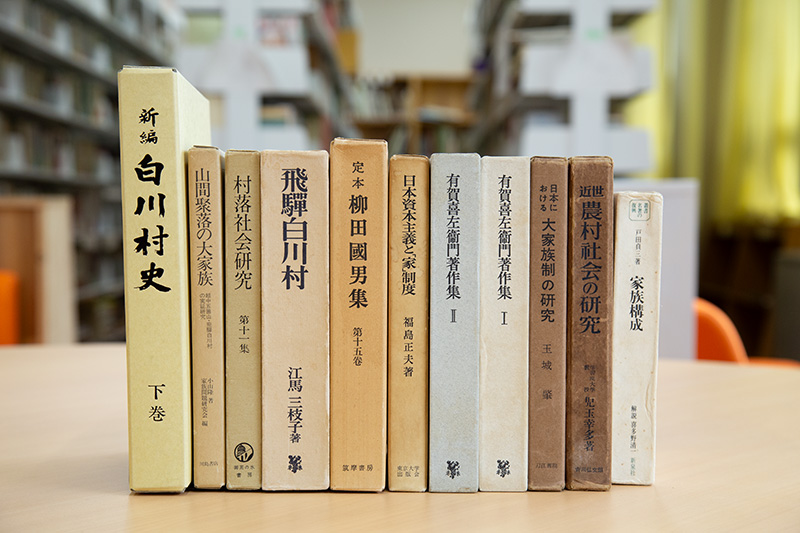
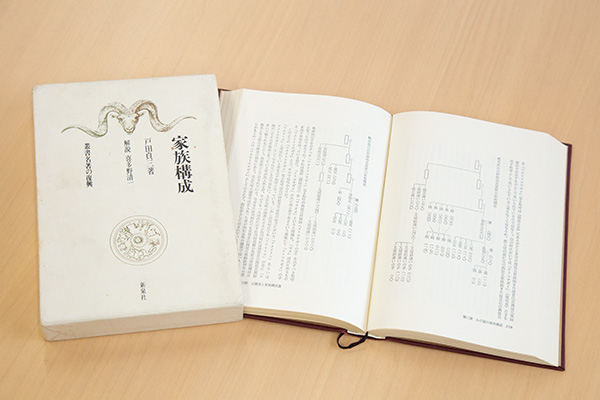
Teizo Toda (1887–1955)
Sociologist; Professor Emeritus at Tokyo Imperial University. A specialist in family sociology. Using individual records from Japan’s first national census conducted in 1923, he clarified the structure of households nationwide in 1920, thereby establishing the foundations of sociology in Japan as an empirical science.
He conducted a detailed examination of family composition in six settlements of the Nakagiri District in Shirakawa Village, drawing attention to the fact that Shirakawa’s large families were characterized not only by a high average number of household members per dwelling, but also by complex relational structures in terms of kinship ties to the household head.
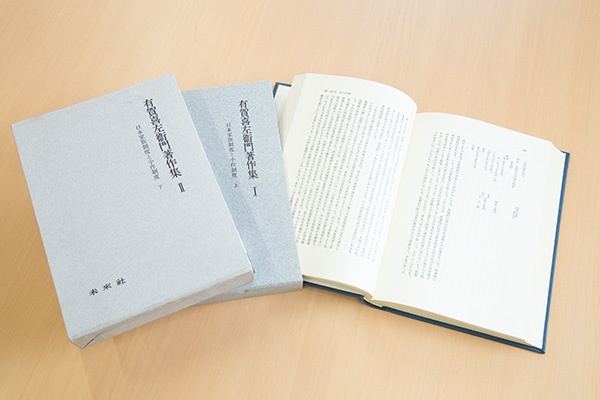
Kizaemon Aruga (1897–1979)
Sociologist; Professor at Tokyo University of Education and Keio University; President of Japan Women’s University. A disciple of Kunio Yanagita, he established the theoretical foundations of rural sociology.
He classified household forms into “simple households” (in which only the household head and direct-line relatives may have spouses) and “compound households” (in which collateral relatives and even non-blood relatives may also have spouses). He argued that the Shirakawa Village “large family” system represents a distinct type of Japanese household (namely, a compound household) rather than merely a family unit.
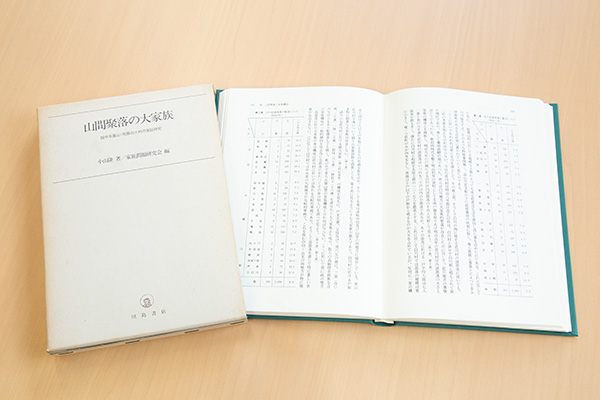
Takashi Koyama (1900–1983)
Sociologist; Professor at Osaka University, Tokyo Metropolitan University, and Toyo University; President of the Japan Sociological Society.
Before World War II, he studied large families in Japan; after the war, he focused on changes in Japanese families and the process of nuclearization. In his paper Large Families in Mountain Villages (1988), he stated: “The so-called large families of Shirakawa Village should not be dismissed simply on the basis of the number of people involved. In general, a large family is a parent–child-centered household, but the large family discussed here is a broad blood-kin community that includes collateral relatives as well.”
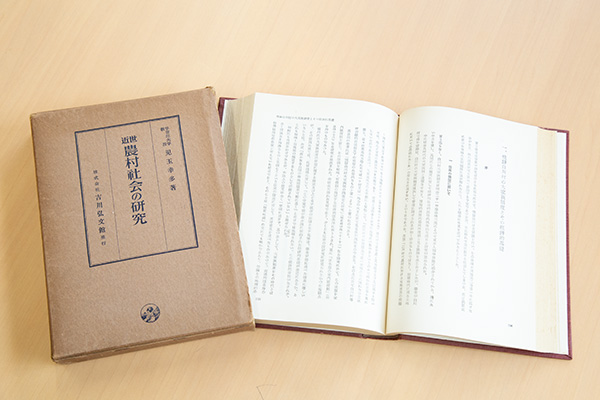
Kota Kodama (1909–2007)
Socioeconomic historian; Doctor of Letters; Professor Emeritus and former President of Gakushuin University. He also served in the Imperial Household’s educational program, lecturing on Japanese history to Emperor Showa and the current Emperor.
In his 1949 paper The Large Family System of Hida Shirakawa Village and Its Economic Foundations, he discussed the definition of large families as follows: “Under the unified control of a single household head, the mutual lives of family members are made possible. In addition to what are today usually called families, if there exists a considerable number of providers of labor—regardless of blood relation or co-residence—I think it appropriate to call such a unit a large family. Although the exact number is debatable, provisionally setting it at around ten persons would likely accord with common understanding.”
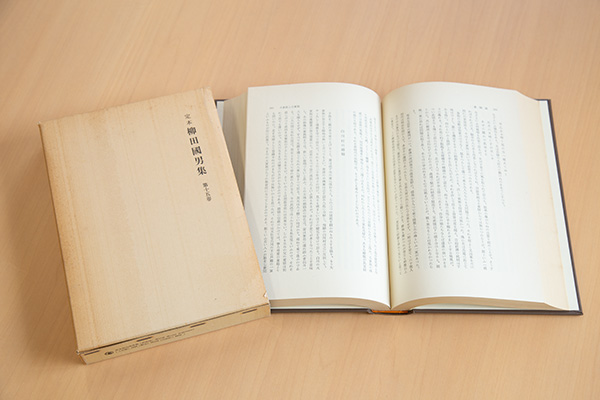
Kunio Yanagita (1875–1962)
Folklorist and pioneer of Japanese folklore studies. In his essay “Large Families and Small Families” (1940), Yanagita argues that large families did not emerge simply by “swelling” from existing family units. Rather, they were formed by “treating many non-children as children, or by greatly expanding the scope of who is regarded as a child,” and by the existence of “second and third ‘parents’ who could take the place of a common great ancestor,” among other conditions.
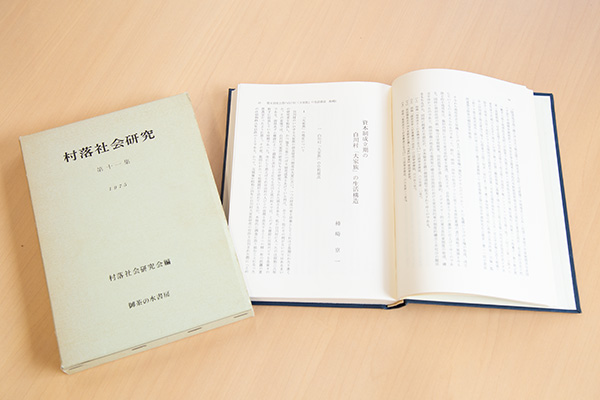
Kyoichi Kakizaki (born 1926)
Sociologist; Professor at Utsunomiya University and Waseda University; Professor Emeritus at both institutions; former Superintendent of Education of Shirakawa Village.
Beginning in 1953, he visited Shirakawa Village and commenced research on large families. Through long-term fieldwork, he discovered local historical documents that had eluded many earlier researchers, providing concrete evidence of the “large family” system from the early modern through Meiji periods. These included religious population registers from the Bunsei era held by the Fujii family—who served as jointly appointed village headmen for Hatogaya and three other villages—as well as the Record Book of Shingai Goods, a 40-year record (from 1853 to 1891) of private goods purchased by the household head, held by the Toyama family. Based on these household documents, Kakizaki conducted rigorous empirical research grounded in scientific evidence.
As a result, he concluded that the “large family” system of Shirakawa Village did not arise from some unusual or exotic custom, but rather was a living system consciously created to enable people to live better under the severe conditions imposed by their environment.