History of Preservation
Preservation History and Efforts in Shirakawa-go and Gokayama
―― Gassho Style Houses Reduced by 92% in a Century
The villages of Shirakawa-go and Gokayama, composed mainly of gassho style houses, gradually expanded from the late Edo period up until before the Pacific War. This was due in part to the increased production of saltpeter and sericulture, which supported steady growth in household numbers. However, after World War II, rapid economic development dramatically transformed life in these mountain farming villages. At the same time, depopulation advanced as people migrated to cities. Since gassho style houses had been built to accommodate the sericulture industry, the postwar decline in demand for silkworm raising led to the replacement of traditional houses with modern homes.
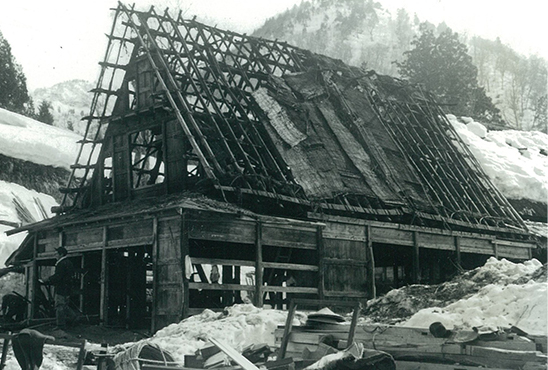
A Gassho Style House Dismantled in Taira Village (Gokayama)
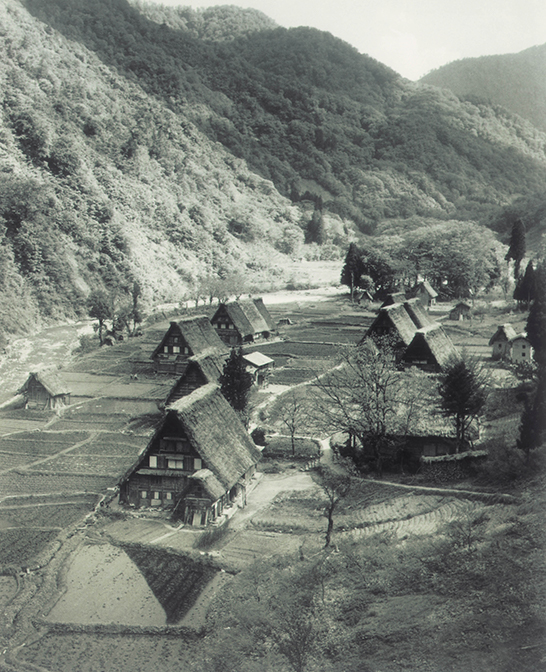
The Mass Relocation of the Kazura Village (Shirakawa-go) in 1967
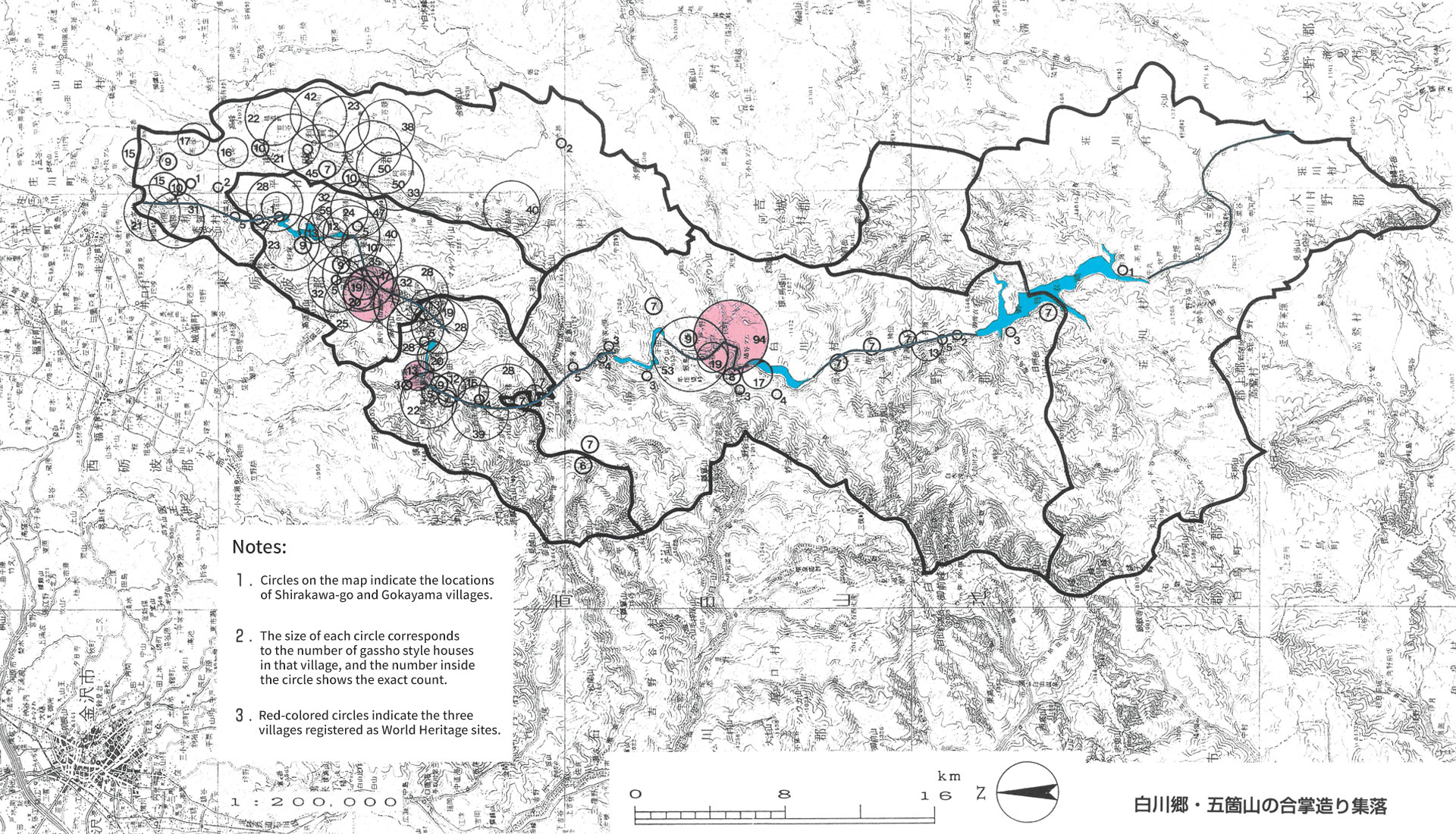
Comparing the situation of today with data from about a century earlier, we find that in the late 19th century, Shirakawa-go and Gokayama together had 93 villages with more than 1,800 gassho style houses. By 1994, however, 60 villages (including 17 that disappeared entirely) had lost all of their gassho style houses, leaving only 144 houses standing across the region. This means that in the span of a century (particularly during the roughly 25 years after the war) an astonishing 92% of gassho style houses were lost.
During this period of decline, many houses were dismantled and relocated to open-air museums around Japan, or repurposed as restaurants and tourist facilities in urban areas. Some of these continue to be used to this day, while others have proven difficult to maintain and have been demolished. In any case, this clearly demonstrates that gassho style houses represent a very rare form among Japanese wooden dwellings, and that they were exceptionally valuable buildings.
Distribution of Gassho Style Houses in the Late 19th Century
Distribution of Gassho Style Houses in 1994
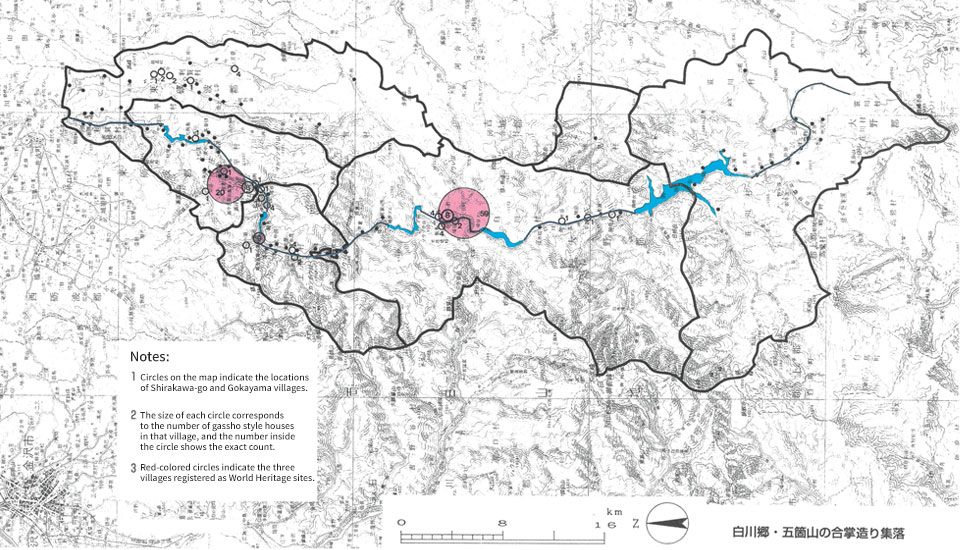
*Hidetoshi Saito, World Heritage: The Gassho Style Villages of Shirakawa-go and Gokayama, 1996
*Hidetoshi Saito, World Heritage: The Gassho Style Villages of Shirakawa-go and Gokayama, 1996
―― History of Preservation
Amid this situation, the need for preservation was strongly voiced in the Ogimachi settlement of Shirakawa Village. In 1971, local residents formed the Association to Protect the Natural Environment of Shirakawa-go Ogimachi Settlement. They adopted a residents’ charter and launched a movement to preserve not only the gassho style houses, but also the rice paddies, fields, village roads, and forests that together created the historical landscape of the settlement. As a result, following the 1975 revision of the Law for the Protection of Cultural Properties, which newly introduced the system of Important Preservation Districts for Groups of Traditional Buildings, Shirakawa Village enacted a local ordinance in 1976 to preserve Ogimachi Village. That same year, it was selected as an Important Preservation District for Groups of Traditional Buildings by the national government.
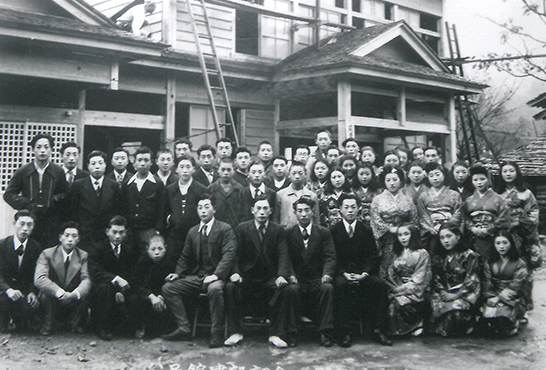
Youth of Ogimachi at the time of the Association’s founding
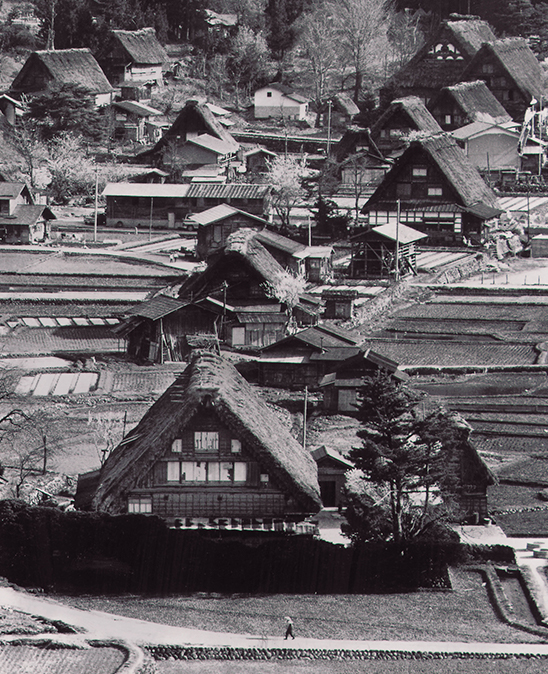
Ogimachi Village around the time of its designation as an Important Preservation District
Meanwhile, the Agency for Cultural Affairs (then the Cultural Properties Protection Commission), recognizing the seriousness of the situation, conducted academic surveys of private houses in Shirakawa-go and Gokayama in 1951 and 1956. Based on these surveys, two houses in Shirakawa Village (the Former Oto Residence and the Former Toyama Residence) were designated Important Cultural Properties in 1956 and 1971. In 1958, two houses in Taira Village (the Haba Residence and the Murakami Residence) and one house in Kamitaira Village (the Iwase Residence) were likewise designated Important Cultural Properties and preserved on site. Later, in 1970, at the request of both villages in Gokayama, the government designated as a National Historic Site the Ainokura Settlement in Taira Village and the Suganuma Settlement in Kamitaira Village, along with their surrounding forests, which were relatively well preserved.
In preparation for World Heritage inscription in 1995, the system of Important Preservation Districts for Groups of Traditional Buildings was also introduced in the Ainokura and Suganuma Settlements, so that preservation methods could be unified. The system was implemented in August 1994, and by December of the same year, both settlements had been designated as Important Preservation Districts for Groups of Traditional Buildings by the government.
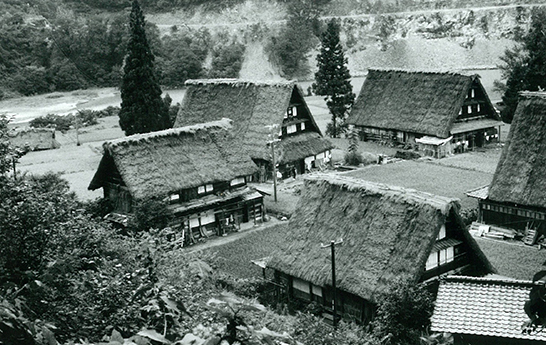
Suganuma Settlement before Historic Site designation (around 1959)
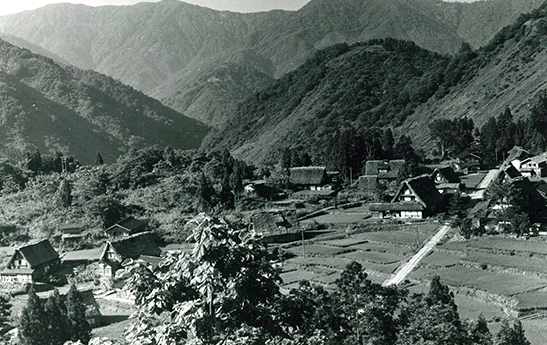
Ainokura Settlement before Historic Site designation (around 1957)
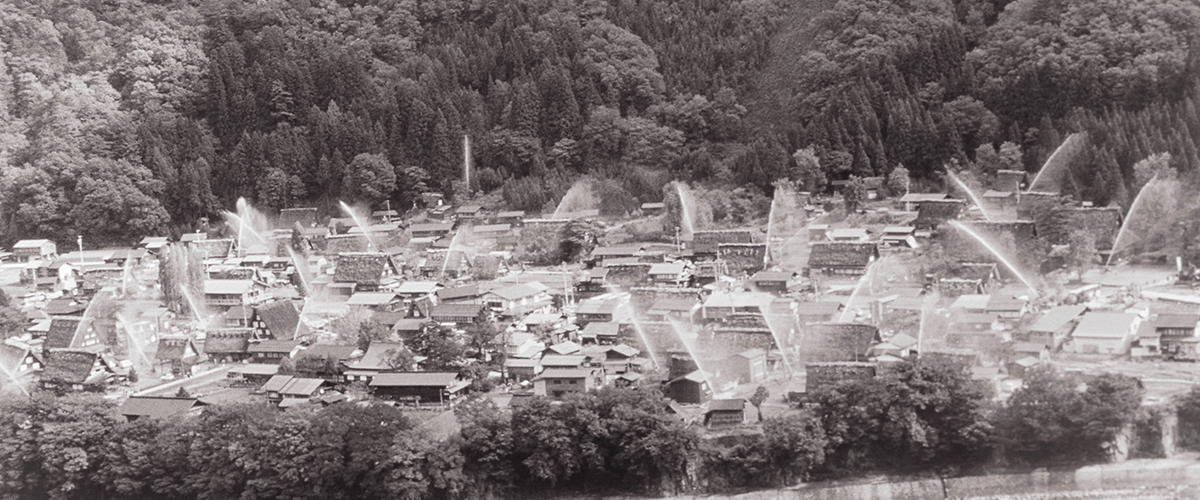
First water discharge after completion of firefighting water cannons in Ogimachi Settlement, 1981
―― Fire Prevention Measures
First water discharge after completion of firefighting water cannons in Ogimachi Settlement, 1981
Gassho style houses are wooden, thatched-roof buildings with a very high risk of fire. For this reason, once the villages were designated as preservation districts, one of the first efforts undertaken was the development of firefighting systems. In the Ogimachi Settlement, 60 water cannons with hydrants and 62 fire hydrants are installed throughout the village. A 600-ton water reservoir has been constructed on high ground to the north, and by using the natural pressure difference, a gravity-fed water discharge system was established. The Ainokura Settlement is equipped with 37 water cannons, 14 fire hydrants, and 7 fire cisterns (with a total capacity of 2,005 tons). The Suganuma Settlement has 24 water cannons, 5 fire hydrants, and 5 cisterns (with a total capacity of 740 tons). The water cannons are intended to protect gassho style houses from catching fire due to sparks or flames spreading from nearby buildings. By creating a “curtain of water,” they serve as a shield against fire spread. Once a year, a large-scale joint water-discharge drill is carried out.
The management of these firefighting facilities is handled by the residents themselves. In Ogimachi, for example, residents take turns on a daily rotation to inspect the intake points that draw mountain spring water into the fire cisterns.
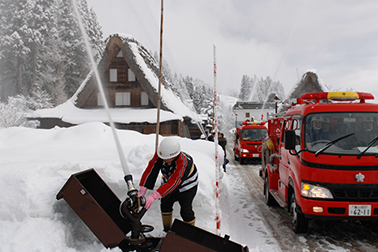
Water discharge drill in Ainokura Settlement
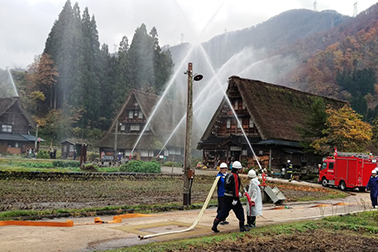
Water discharge drill in Suganuma Settlement
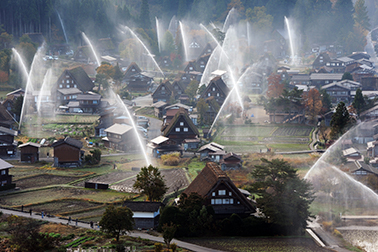
Water discharge drill in Ogimachi Settlement