The Period of Decline in Gassho Style Houses
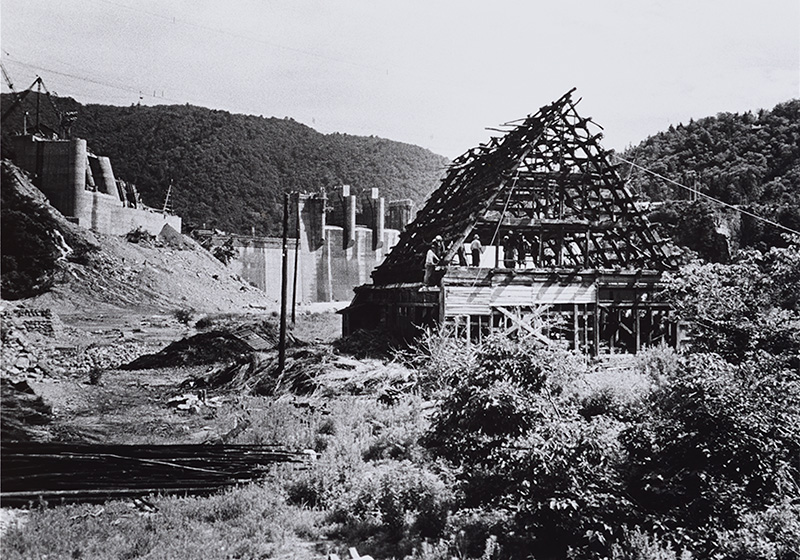
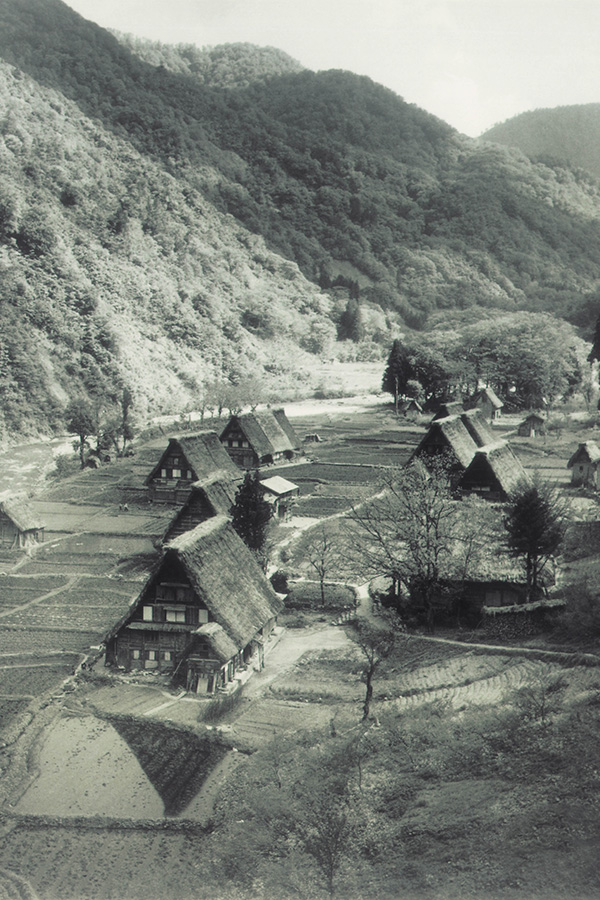
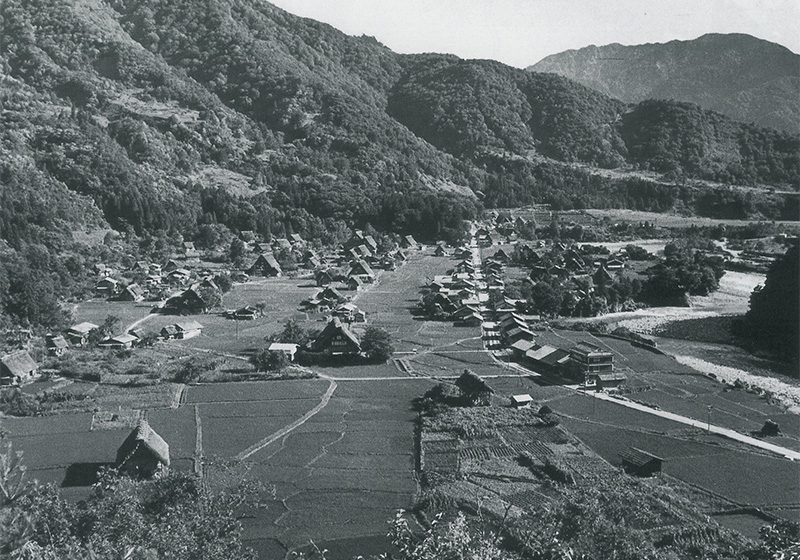
Originally, during the Taisho period, Shirakawa Village had more than 300 gassho style houses. This number accounted for approximately 75% of all households in the village at the time. However, in the postwar period, by 1951, the proportion had fallen to about 45%, dropping to less than half. Thereafter, by 1961, the number had declined to 191 houses, meaning that nearly 30% disappeared in a short span of time. The primary cause was the construction of dams for hydroelectric power development along the Sho River. From 1952 to 1958, construction projects began downstream along the Sho River, resulting in the disappearance of the gassho style villages of Ogami, Akimachi, Fukushima, and Maki. Subsequently, by 1970, the number had further decreased to 133 houses. Although dam construction had largely come to an end by this time, Japan was entering a period of rapid economic growth. Large corporations purchased mountain forests, accelerating depopulation and the dismantling of houses. At the same time, the sharp decline in demand for sericulture compounded the situation, and rebuilding into non-gassho style houses progressed steadily.
Designation of Gassho-Style Houses as Cultural Properties
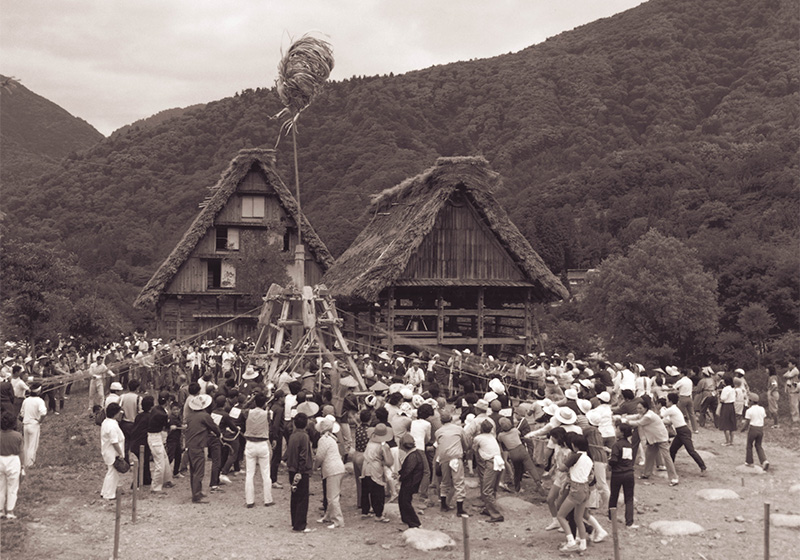
As gassho style houses continued to decline, awareness of their value as cultural properties gradually increased. Amid this growing momentum, the former Oto Residence (1956) and the former Toyama Residence (1971) in Miboro were designated as Important Cultural Properties of Japan. In Ogimachi, the bell tower gate and priest’s quarters of Myozen-ji Temple were designated as prefectural cultural properties (1968). In this way, preservation measures as cultural assets began to be implemented. During this same period, construction also began on “Gassho Village” (now the Outdoor Museum Gasshozukuri Minkaen), where gassho style houses relocated from abandoned villages were re-erected and opened to the public. The village opened in 1972. Through these efforts, the cultural heritage value of gassho style houses came to be re-recognized both within and beyond Shirakawa Village.
The Birth of the Preservation Society
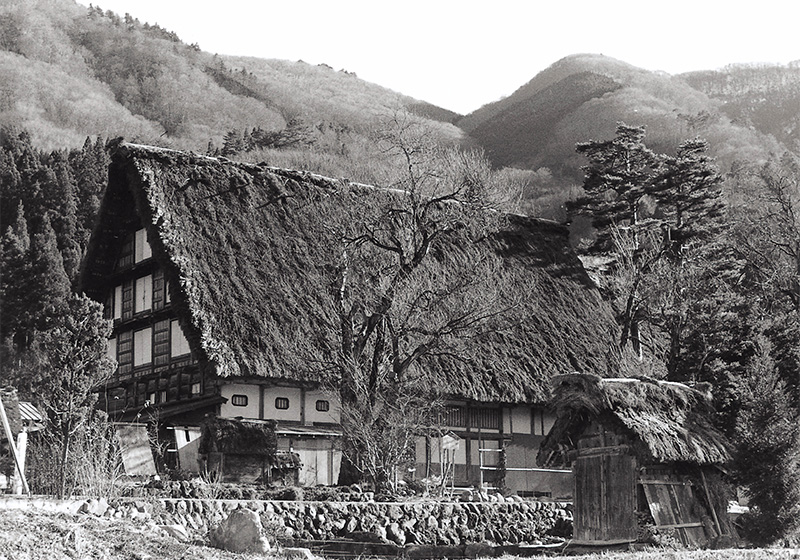
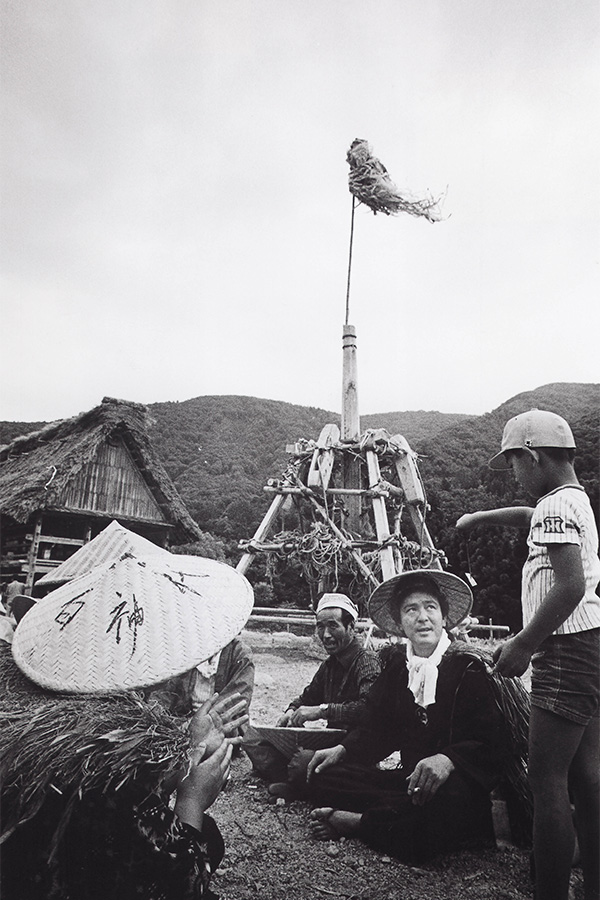
During the 1960s, Shirakawa Village was at a turning point, as it sought new industries to replace sericulture, which had been its principal livelihood since the early modern and modern periods. At the time, village policy promoted agriculture based on three pillars—sericulture, livestock farming, and rice cultivation—but sericulture began to decline from 1972 and had ceased altogether by 1979. Meanwhile, this period also saw a transportation revolution, marked by national highway improvements, the opening of the Hakusan Super Forest Road, and the Tokai–Hokuriku Expressway. As a result, expectations among villagers grew for developing the community through tourism.
Against this backdrop, a movement to preserve the streetscape of the post town of Tsumago-juku along the Nakasendo in Nagano Prefecture was unfolding at the time. Through exchanges with Toshihiko Kobayashi, who played a leading role in that movement, villagers studied the example of Tsumago-juku. Gradually, a vision took shape that positioned the preservation of gassho-style villages at the core of a strategy for building the community through tourism.
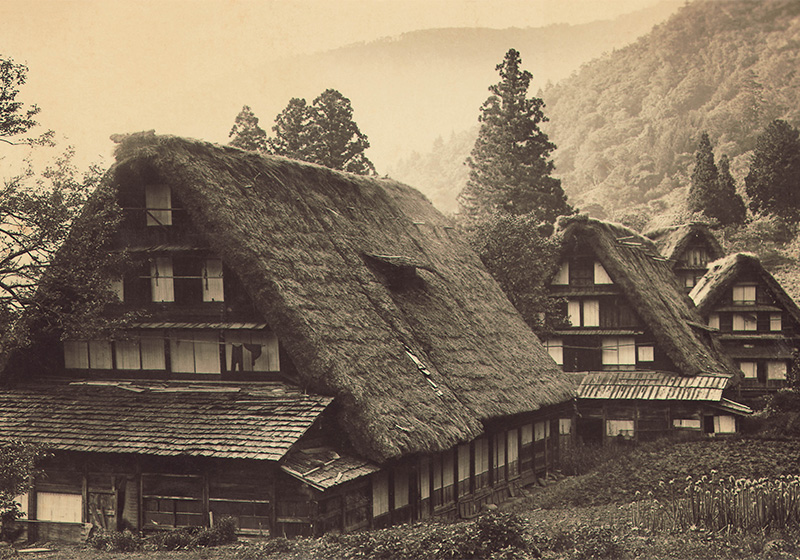
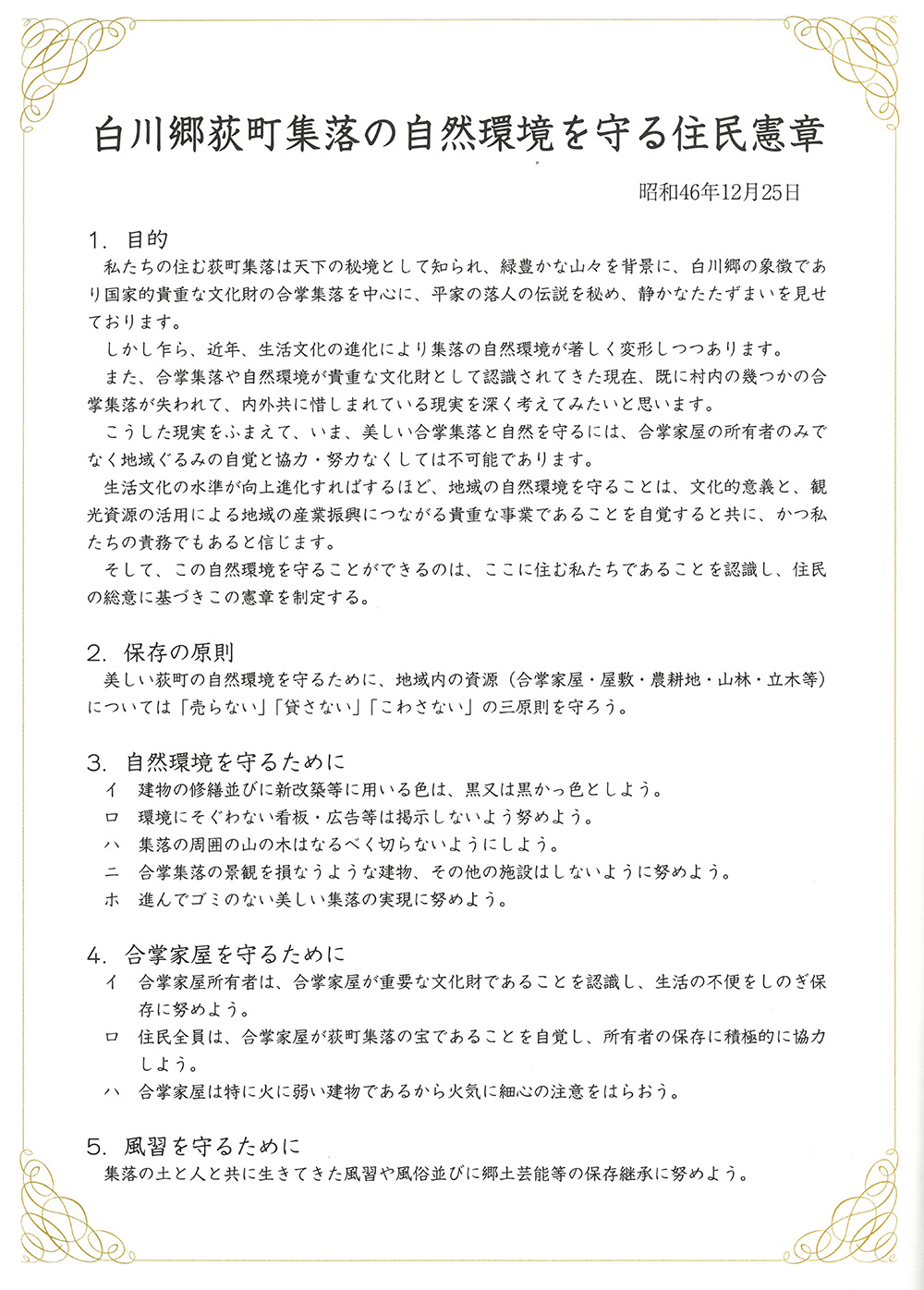
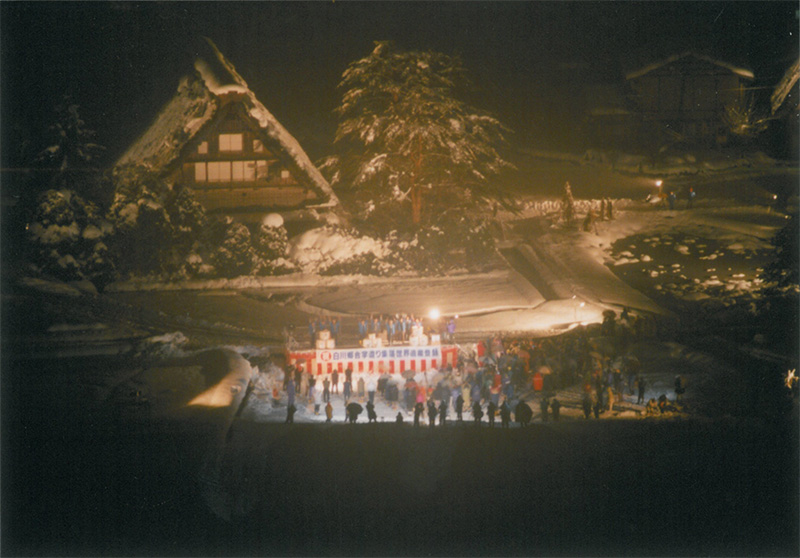
Finally, on December 25, 1971, the “Residents’ Charter for Protecting the Natural Environment of the Ogimachi Village in Shirakawa-go” was proclaimed, and the residents’ preservation organization officially named the “Association for Protecting the Natural Environment of the Ogimachi Village in Shirakawa-go,” commonly known as the Mamoru-kai (Preservation Society), was established. The Residents’ Charter set forth three fundamental principles for preservation—“do not sell,” “do not rent,” and “do not destroy”—with respect to gassho style houses and their surrounding natural environment. It also clearly articulated a forward-looking vision: that preservation would lead to the revitalization of local industry through the effective use of tourism resources. The people of Ogimachi have continued to uphold the ideals of this charter, working for more than half a century to preserve the village landscape of gasshostyle houses.
Residents’ Charter for Protecting the Natural Environment of the Ogimachi Village in Shirakawa-go
*Click to enlarge
Designation as the First Important Preservation District for Groups of Traditional Buildings in Japan
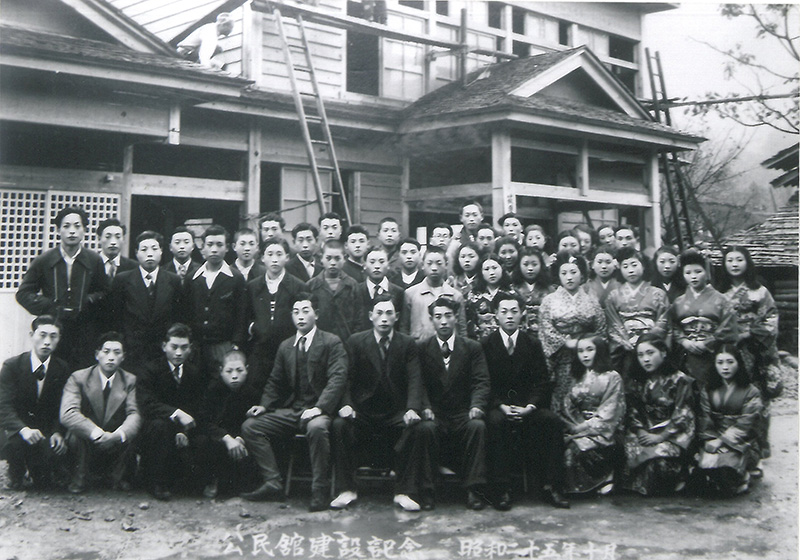
Preservation efforts in Ogimachi began as a resident-led initiative, but significant financial challenges remained, particularly the costs associated with re-thatching roofs and repairing the structural framework of gassho style houses. At the time the Preservation Society was formed, Japan lacked any formal system to support the preservation of entire villages. As a result, the Preservation Society actively petitioned the national government directly and engaged in other advocacy efforts. These activities helped raise public awareness and momentum nationwide for townscape preservation. In 1975, revisions to the Cultural Properties Protection Law led to the creation of the system of Important Preservation Districts for Groups of Traditional Buildings (hereafter, “Preservation Districts”). In the following year, 1976, seven districts—including Tsumago, Hagi in Yamaguchi Prefecture, and Sanneizaka in Kyoto—were designated under this new system. Ogimachi was selected as one of these districts, becoming part of the first group designated as an Important Preservation District for Groups of Traditional Buildings.
World Heritage Inscription
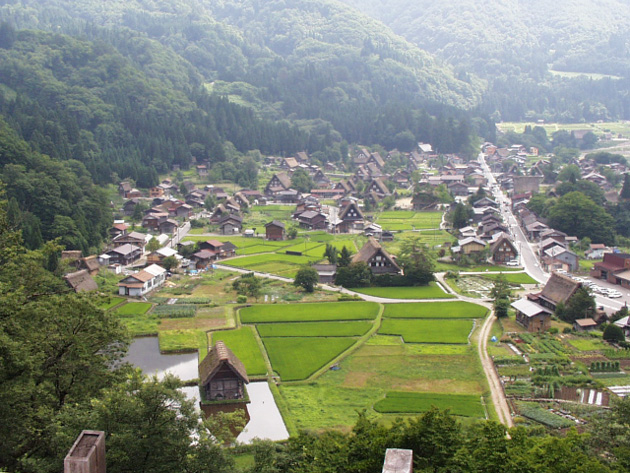
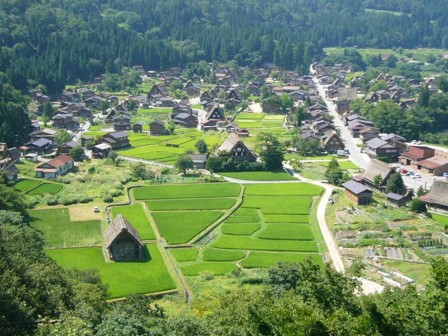
Following its designation as an Important Preservation District for Groups of Traditional Buildings, administrative support systems were put in place, and projects aimed at safeguarding the villages—such as disaster-prevention measures and conservation and repair programs—were actively implemented. These initiatives, grounded in the residents’ preservation movement led by the Preservation Society, bore fruit in 1995, when Shirakawa-go was inscribed as a World Cultural Heritage site. Today, it has grown into a major tourist destination attracting more than two million visitors annually. Among Japan’s World Heritage sites, Shirakawa-go is unique in that the living village itself is recognized as heritage, drawing attention as a “living heritage.” Thus, gassho style houses, originally built as sericulture farmhouses, have been given new life through the preservation efforts of the Preservation Society over the past half century, guiding Shirakawa Village toward sustainability.
The Activities of the Preservation Society
The landscape of the Ogimachi gassho style village in Shirakawa-go is preserved through the daily efforts of the Preservation Society. In modern society, the preservation of traditional townscapes and villages cannot be achieved without the voluntary conservation awareness of the people who live there. The Preservation Society is composed of all residents living in Ogimachi, and through the sustained preservation awareness of each individual member, the village has been protected for more than half a century.
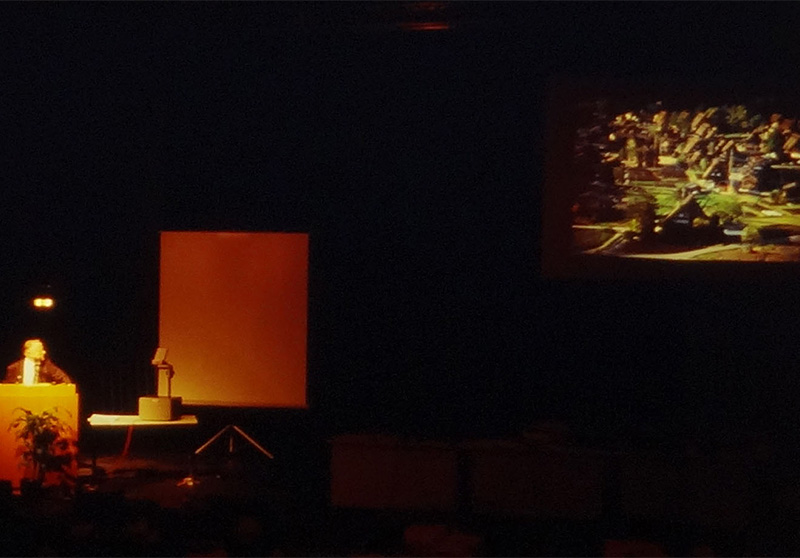
One of the core activities of the Preservation Society is the monthly “Preservation Society Regular Meeting.” Within an Important Preservation District, any actions that alter the existing conditions—such as building extensions or renovations, or changes to land form—require submission of an “Application for Alteration of the Existing State” to the Shirakawa Village Board of Education. At the regular meetings, these applications, submitted on an ongoing basis, are reviewed and discussed to determine whether they conform to the standards of the preservation district.
For proposals that do not meet the standards, the Preservation Society attaches its views in the form of a “Preservation Society Opinion Statement” and submits it to the Board of Education. The Board then makes a final decision based on this opinion and grants or denies permission to the applicant. In cases that do not conform to the standards, there are often occasions when strict opinions are exchanged.
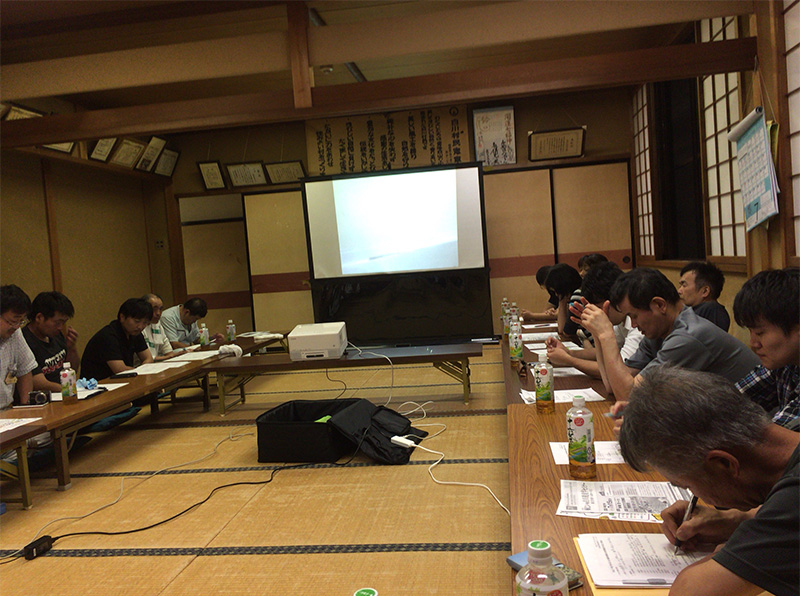
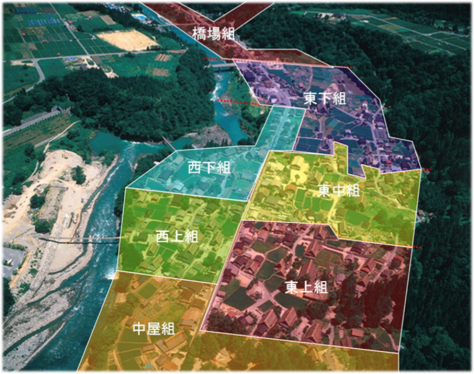
Ogimachi is composed of seven neighborhood groups, and the Preservation Society officers from each group gather every month.
Participants in these meetings include Preservation Society officers from each neighborhood group in Ogimachi, representatives from business associations such as the innkeepers’ association and souvenir shop association, representatives of the youth association, and officers of the women’s association. In particular, because Preservation Society officers from each neighborhood group rotate every two years, participation is not limited to a fixed set of individuals. Over time, this role comes around to nearly every household in Ogimachi, meaning that virtually all families have experienced serving as Preservation Society officers. The history of many residents engaging in such voluntary discussions and repeatedly deliberating on preservation is what has created the World Heritage gassho style village landscape seen today.
World Heritage Shirakawa-go Gassho-Zukuri Preservation Foundation
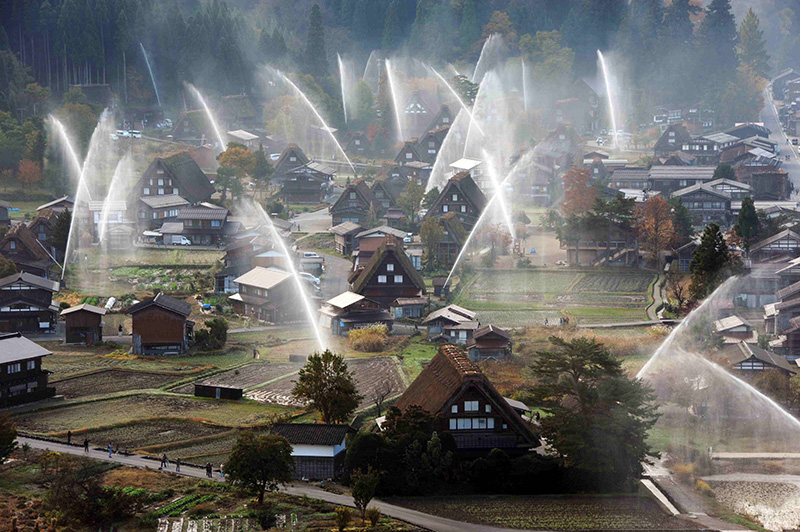
Following the inscription of Shirakawa-go as a World Heritage site in 1995, the World Heritage Shirakawa-go Gassho-Zukuri Preservation Foundation (hereafter, the Gassho Foundation) was established in 1996 through joint investment by Gifu Prefecture and Shirakawa Village, with the aim of promoting conservation within the World Heritage area. While administrative conservation projects in the World Heritage district—such as disaster-prevention measures, re-thatching of gassho-style roofs, and fundamental repairs to structural frameworks—are implemented with national support, the Gassho Foundation undertakes complementary initiatives. These include maintenance work such as replacing ridge thatch and inserting supplemental thatch, as well as providing support for landscape-enhancing construction on buildings other than gassho style houses. In addition, the foundation carries out projects to restore farmland that has become fallow, provides activity funding support to the Preservation Society, and conducts various surveys related to preservation. Through these efforts, it has established a system capable of delivering finely tuned projects essential to the conservation of the World Heritage area.
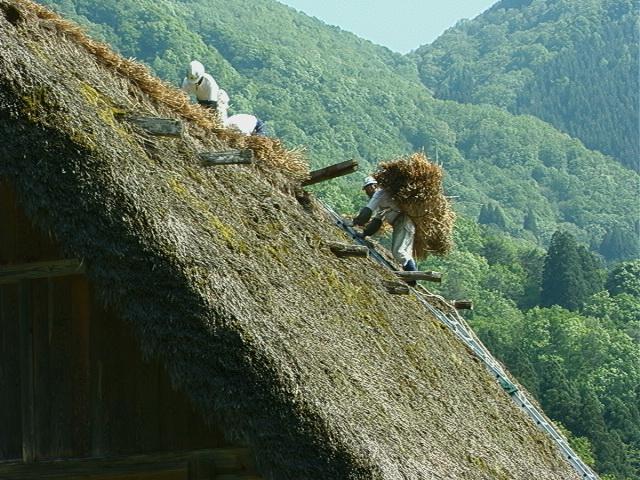
Because gassho style houses require annual replacement of ridge thatch in early spring, the foundation provides financial support for these costs.
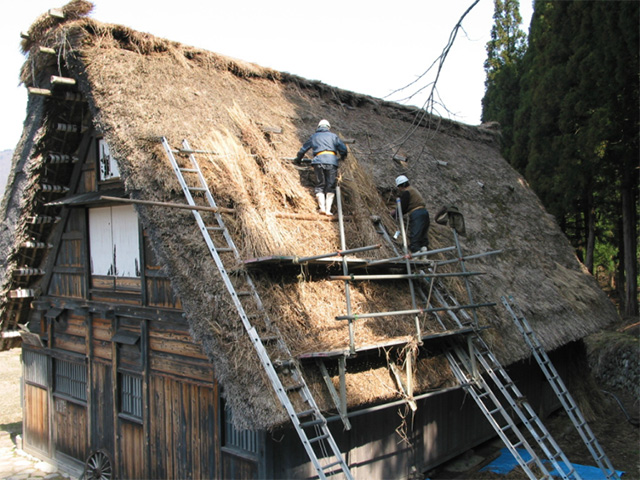
Supplemental thatch is inserted into areas where snow accumulation during winter has pulled out thatch, leaving holes.
The financial resources for these projects are derived from parking fees at the Seseragi Park Public Parking Lot, located across the river from the World Heritage district. The Gassho Foundation also manages and operates this parking facility. By utilizing village-based financial resources, the foundation has been able to respond carefully and flexibly to the daily requests for preservation support arising from the World Heritage area, thereby advancing comprehensive conservation assistance.
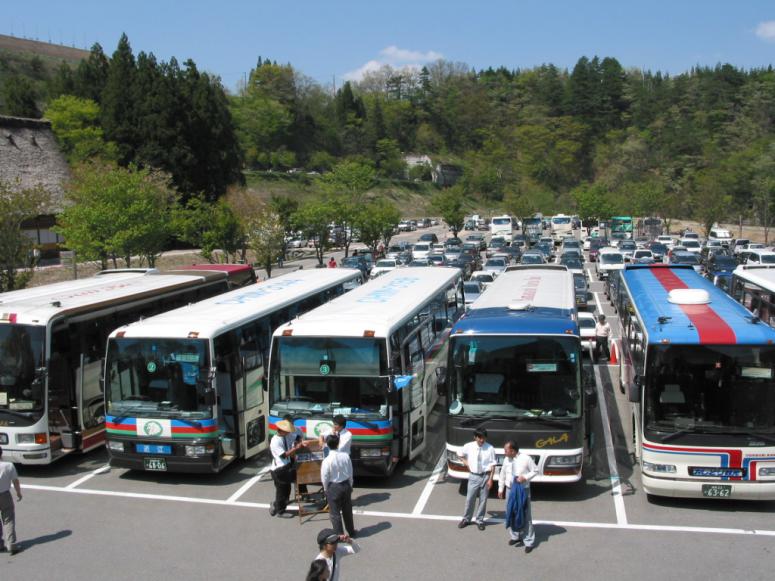
Parking fees from the Seseragi Park Public Parking Lot serve as the financial foundation for preservation projects.