Historic Villages of
Shirakawa-go and Gokayama
World Heritage Center
    • English
    • 日本語
    • 简体中文
    • 繁體中文
    • English
    • 日本語
    • 简体中文
    • 繁體中文
Shirakawa-go and Gokayama
Panoramic Sky View
Value as a World Heritage Site
Extent of the Heritage Site
History and Industry
The Three Villages

Shirakawa-go Ogimachi

Gokayama Ainokura

Gokayama Suganuma

Learn About Gassho Style Houses (Gassho-zukuri)

Structure of Gassho Style Houses

Differences Between Shirakawa-go and Gokayama

Formation of Gassho Style Houses

History of Preservation
Metaverse
Community World
To Shirakawa-go

Yui Roof-Thatching

Preservation History & Initiatives

The Large Family System and Gassho Style Houses

Mt. Hakusan and Gassho Style Houses

News

Mt. Hakusan and Gassho Style Houses

  1. TOP
  2. To Shirakawa-go
  3. Mt. Hakusan and Gassho Style Houses

Mt. Hakusan and Gassho Style Houses

 The presence of Mt. Hakusan played a major role in the emergence of gassho style houses in Shirakawa-go. The formation of this architectural style was primarily influenced by the following two factors created by Mt. Hakusan:

1.Mountainous Terrain with Limited Flat Land

 Beginning around 400,000 years ago, volcanic activity of Mt. Hakusan caused significant uplift in the region, leaving Shirakawa-go as a mountainous area with very little flat land. With limited farmland available, the people of Shirakawa turned to sericulture as their primary livelihood, engaging in commercial production that made effective use of mountainous terrain.

2.One of the World’s Heaviest Snowfall Regions

 In winter, Mt. Hakusan blocks the northwesterly seasonal winds laden with moisture from the Sea of Japan, causing heavy snowfall at its foothills. As a result, Shirakawa-go, situated at the base of Mt. Hakusan, became one of the snowiest regions in the world at such a low latitude.

 Thus, the severe natural environment of a mountainous heavy-snowfall region was shaped by Mt. Hakusan. The most distinctive feature of gassho style houses—the steeply pitched gabled roof—was developed to use the attic as a space for raising silkworms. The decision to utilize the attic rather than constructing separate buildings was strongly influenced by the scarcity of flat land, which made it undesirable to sacrifice valuable farmland for additional structures, as well as by the practical need to avoid increasing the number of buildings requiring snow removal during winter.
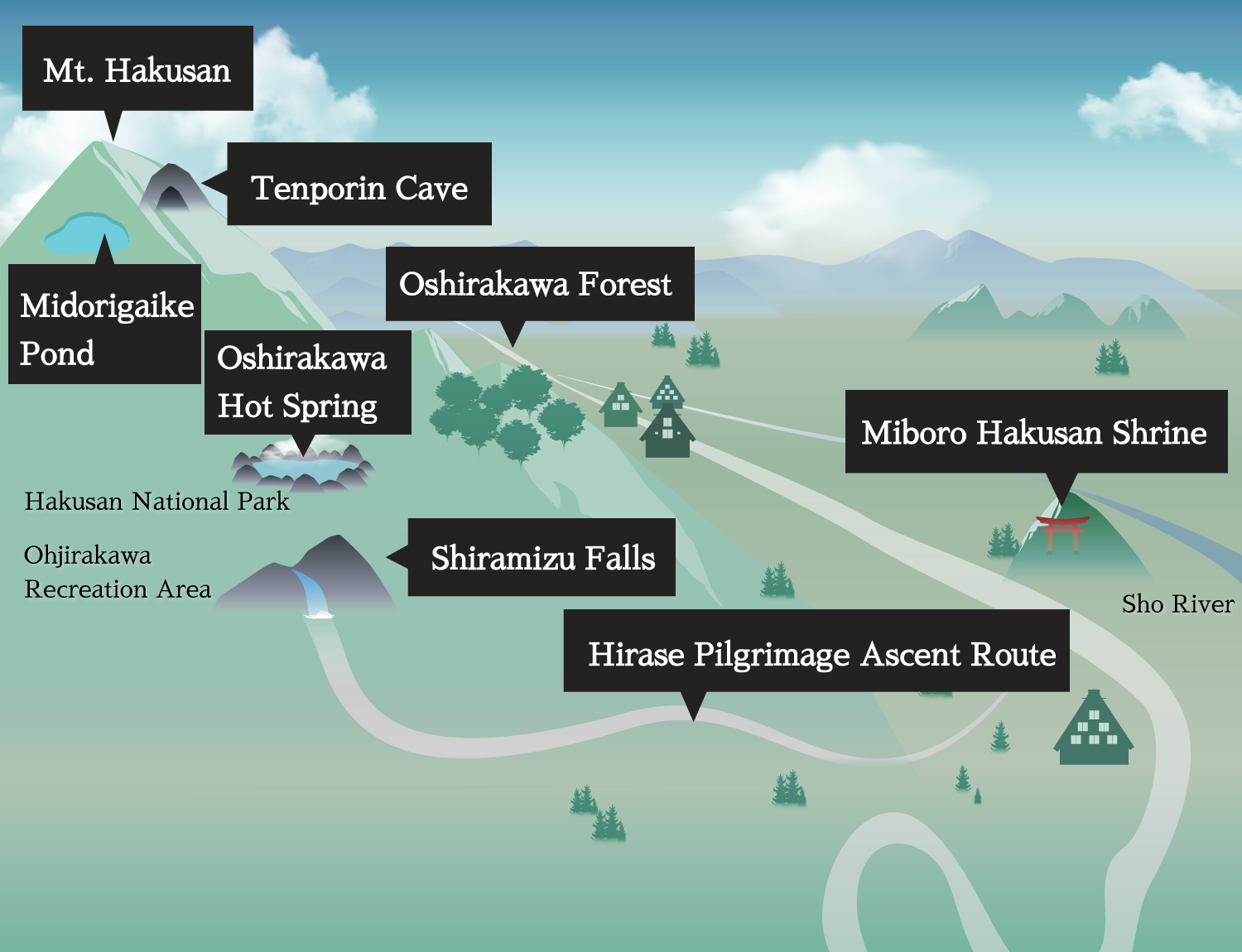
 Here, we take a closer look at Mt. Hakusan, the mountain that gave rise to gassho style architecture.

Click on the relevant sections to view detailed pages.
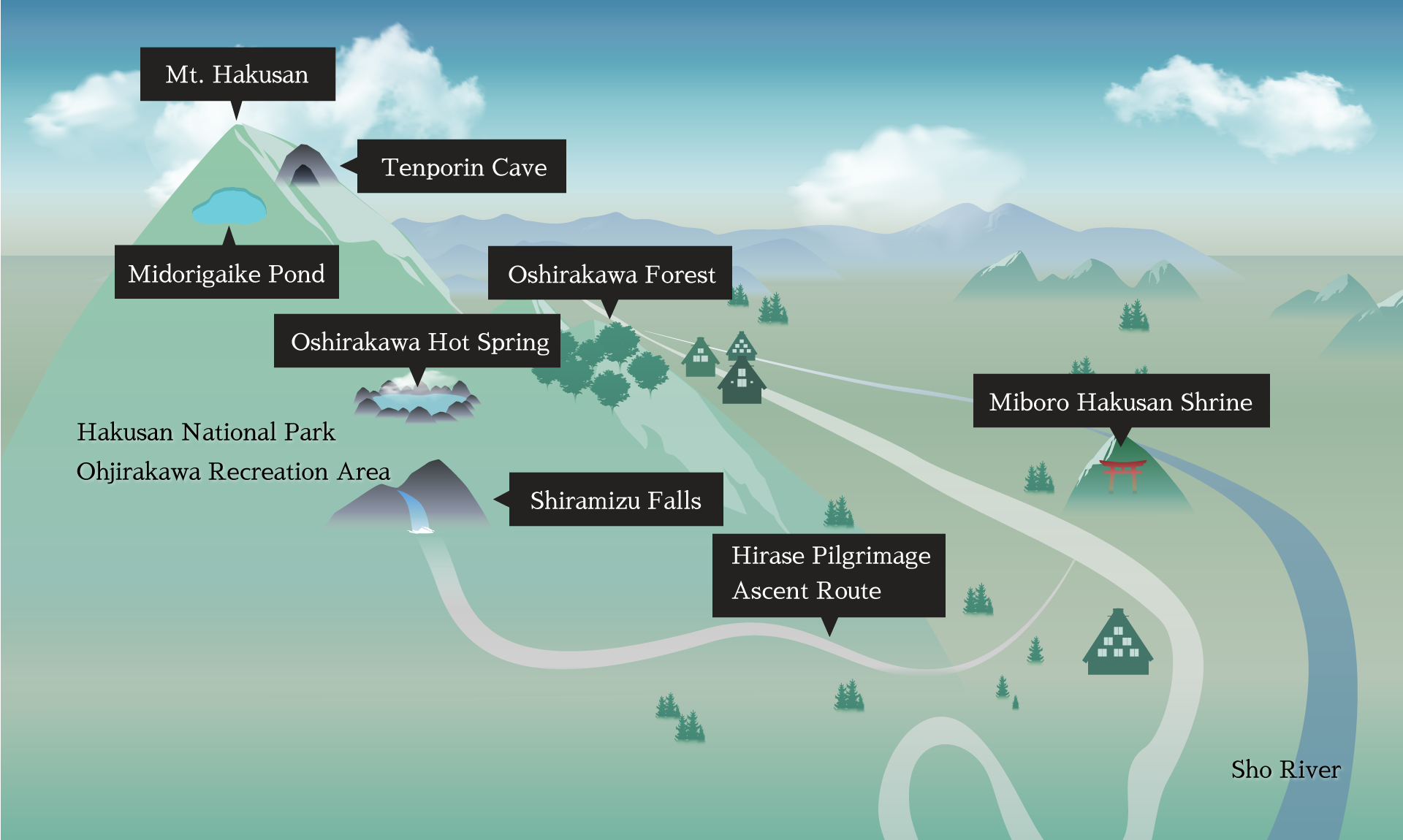
Illustration of the Hakusan Area Mt. Hakusan Tenporin Cave Midorigaike Pond Shiramizu Falls Oshirakawa Forest Oshirakawa Hot Spring Hirase Pilgrimage Route Miboro Hakusan Shrine
Illustration of the Hakusan Area
  • Mt. Hakusan
  • Shiramizu Falls
  • Oshirakawa Hot Spring
  • Miboro Hakusan Shrine
  • Oshirakawa Forest
  • Midorigaike Pond
  • Hirase Pilgrimage Route
  • Tenporin Cave
Historic Villages of Shirakawa-go and Gokayama
World Heritage Center
Shirakawa-go and Gokayama
Panoramic Sky View
Value as a World Heritage Site
Extent of the Heritage Site
History and Industry
The Three Villages
Shirakawa-go Ogimachi
Gokayama Ainokura
Gokayama Suganuma
Learn About Gassho Style Houses (Gassho-zukuri)
Structure of Gassho Style Houses
Differences Between Shirakawa-go and Gokayama
Formation of Gassho Style Houses
History of Preservation
Metaverse
Community World
Yui Roof-Thatching
People Involved in Yui
Roof-Thatching Techniques
Procurement of Thatching Grass
To Shirakawa-go
To Gokayama
News

Inquiries

Shirakawa Village Board of Education
Nanto City Cultural & World Heritage Section
Copyright shirakawa-go.gr. All Rights Reserved