History and Industry
History of Shirakawa-go and Gokayama
— Ancient Shirakawa-go and Gokayama
Shirakawa-go and the Gokayama region were opened in the 8th century as training grounds for mountain ascetics devoted to the worship of Mt. Hakusan, and for a long time remained under the influence of the Tendai Buddhist order. In Shirakawa-go, among the 19 villages of Kamishirakawa-go (former Shokawa Village), 10 enshrined Hakusan shrines, while in Shimoshirakawa-go (present-day Shirakawa Village), eight Hakusan shrines were concentrated in the southern districts. This was because Minochoryu-ji, the Mino training center of the three Hakusan worship sites, had established Hakusan Gongen Shrine in Rokumyo of former Shokawa Village, designating it the regional shrine of Kotori and Shirakawa-go. It was also closely linked to the pilgrimage route from Hida leading to Mt. Hakusan: Miboro → Ohjirakawa → Hakusan Gozengamine. In Gokayama, the tradition begins in the Yoro era (717–723), when Taicho, the founder of Hakusan worship, enshrined Hakusan at Ningyozan (a 1,726 m peak straddling the border between Etchu and Hida). The area prospered as a base for Hakusan worship and a training ground for ascetics. In 1125, the Hakusan shrine was moved to Kaminashi, and in 1502 the current Hakusan Shrine Main Hall was constructed. This building has been designated an Important Cultural Property of Japan.
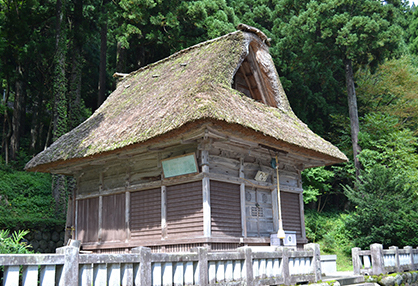
Hakusan Shrine Main Hall and Outer Hall (Kaminashi, Nanto City)
It is said that the monk Taicho, founder of Hakusan worship, opened Ningyoyama, built halls on its summit, and enshrined sacred objects there. The shrine was relocated to its current site in 1125. The pictured outer hall was built in 1760. Inside it stands the Hakusan Shrine Main Hall, the oldest surviving wooden structure in Toyama Prefecture, built in 1502 and designated an Important Cultural Property of Japan.
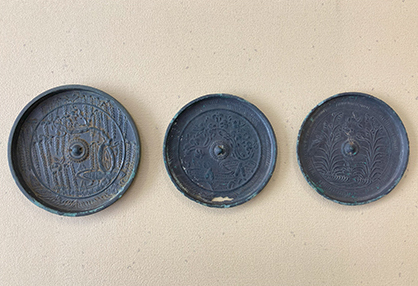
Three Bronze Mirrors Excavated at Ohjirakawa (Owned by Shirakawa Village)
In 1962, three bronze mirrors were discovered during a survey conducted before the construction of the Ohjirakawa Dam in Shirakawa Village. All three are believed to date from the Kamakura period. Similar bronze mirrors have been found at the summit site of Mt. Hakusan’s Gozengamine peak and are thought to have been ritual implements left by ascetics for esoteric prayers.
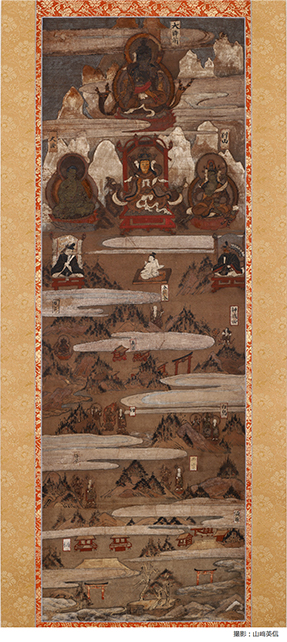
Hakusan Mandala (Hakusan Shrine Collection, Kaminashi, Nanto City)
Dating from the late Muromachi period, this mandala is believed to have been transmitted from Minonagataki-dera to Gokayama. It is the only Hakusan mandala preserved within Toyama Prefecture.
— Medieval Shirakawa-go and Gokayama
From the mid-13th century onward, Jodo Shinshu Buddhism spread into this region, and temples and dojos (preaching halls) were established in each settlement. In Shirakawa-go, it began in 1269, when Kanenbo Zenshun, a disciple of Shinran, the founder of Jodo Shinshu, used the Hatogaya dojo in Shirakawa-go as his base of missionary activity. The hall was later moved to Iijima and became known as Shoren-ji Temple. Supported by devoted followers of Zenshun, the temple flourished, but during the Muromachi period it was defeated in a power struggle with the rising local Uchigashima clan, and Shoren-ji ceased to exist. Later, through the mediation of Rennyo, head of Hongan-ji, peace was made with the Uchigashima, and the temple was renamed Shoren-ji, relocated to Nakano in Shirakawa-go (present-day Shokawa Village), and developed into the chief dojo of Hida Province. In 1588, Kanamori Nagachika, who had pacified Hida, relocated Shoren-ji to Takayama, granting it great patronage. There it expanded into a major temple overseeing more than 70 branch temples, becoming Takayama Betsuin Shoren-ji, the main center of Jodo Shinshu faith in Hida. Thus, Shirakawa-go can be considered the cradle of Jodo Shinshu influence in the region.
Meanwhile, from the late medieval period, the power of Hongan-ji also deeply penetrated Gokayama. Beginning in the Bunmei era (1469–1486), Rennyo’s disciple Doshu of Akao (–1516), who spread Shinshu teachings throughout Hokuriku, played a major role. A written pledge by the Tokamachi confraternity in 1552 records the signatures of 87 leaders representing the five areas of Gokayama—Shimonashi, Togadani, Kotani, Kaminashi, and Akao—swearing annual tribute to the Hongan-ji in the form of silk thread and silk floss. This demonstrates not only the extent of Jodo Shinshu’s control over Gokayama but also the importance of sericulture as a major industry in the area.
Even today, many people in both regions remain devout followers of Jodo Shinshu. Various religious events centered on temples and preaching halls continue to be observed according to tradition, serving as a strong spiritual foundation for local community ties.
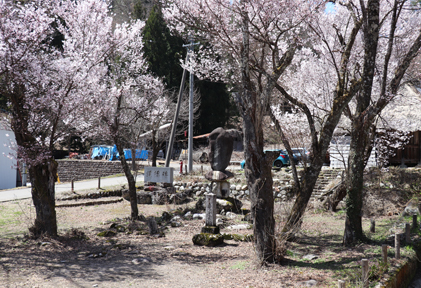
Site of Kanenbo Dojo (Hatogaya, Shirakawa Village)
Kanenbo Zenshun, a disciple of Shinran, founder of Jodo Shinshu, established a dojo in Hatogaya, Shirakawa in 1258. This marked the beginning of the spread of the Shinshu sect in Hida.
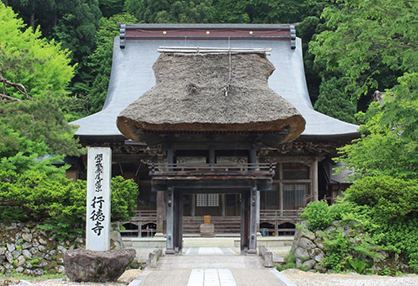
Gyotoku-ji Temple (Akao, Nanto City)
Founded in 1446 by Akao Doshu, a disciple of Rennyo. Originally known as Akao Dojo, it served as his base for spreading Shinshu teachings throughout the villages of Gokayama.
— Early Modern Shirakawa-go and Gokayama
The name Shirakawa-go first appears in written records in the mid-12th century. The name Ogimachi dates from the late 15th century, Gokayama from the early 16th century, Ainokura from the mid-16th century, and Suganuma from the early 17th century, showing that each settlement had already taken shape before those times.
At the beginning of the Edo period, Shirakawa-go was part of the Takayama domain, but from the 17th century until the Meiji Restoration it became a direct domain of the Tokugawa shogunate. Gokayama, on the other hand, remained under the Kanazawa domain (Kaga clan) throughout the Edo period. In the Meiji period, 23 of the 42 villages of Shirakawa-go were incorporated into Shirakawa Village, Gifu Prefecture, while 18 became part of Shokawa Village (present-day Shokawa Town, Takayama City). Ogimachi became part of Shirakawa Village. Of Gokayama’s 70 villages, 25 became part of Taira Village, 19 of Kamitaira Village, and 26 of Toga Village in Toyama Prefecture. Ainokura and Suganuma thus belonged to Taira and Kamitaira Villages respectively, and were integrated into modern administrative structures. In 2004, through municipal mergers, both Ainokura and Suganuma became part of Nanto City, Toyama Prefecture, where they remain today.
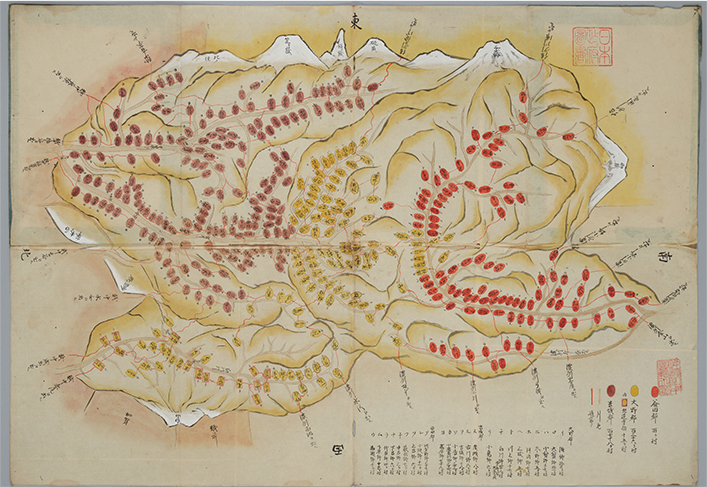
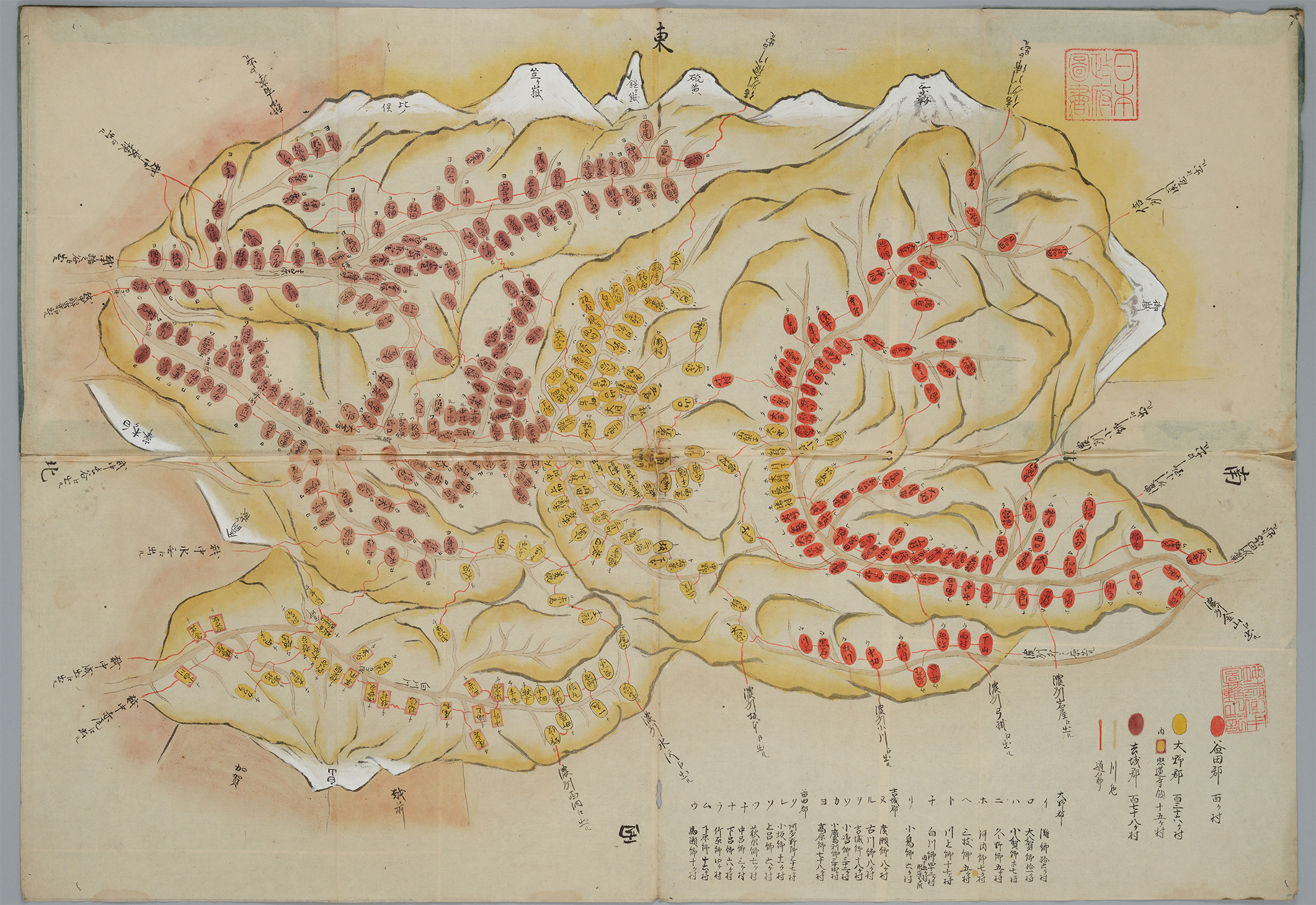
Map of Hida Province (Shogunate Direct Rule Period) – Collection of the National Archives of Japan
A map of Hida Province during the period of direct shogunate rule, showing village names. The counties are color-coded: Yoshiki-gun in purple, Mashita-gun in orange, and Ono-gun, to which Shirakawa-go belonged, in yellow. Mt. Hakusan is depicted at the lower left, with the 42 villages of Shirakawa-go shown at its base, including Ogimachi.
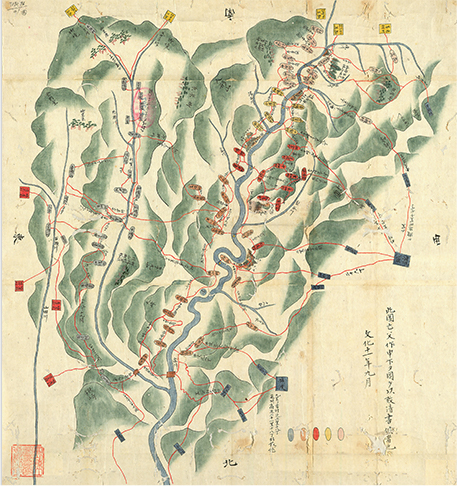
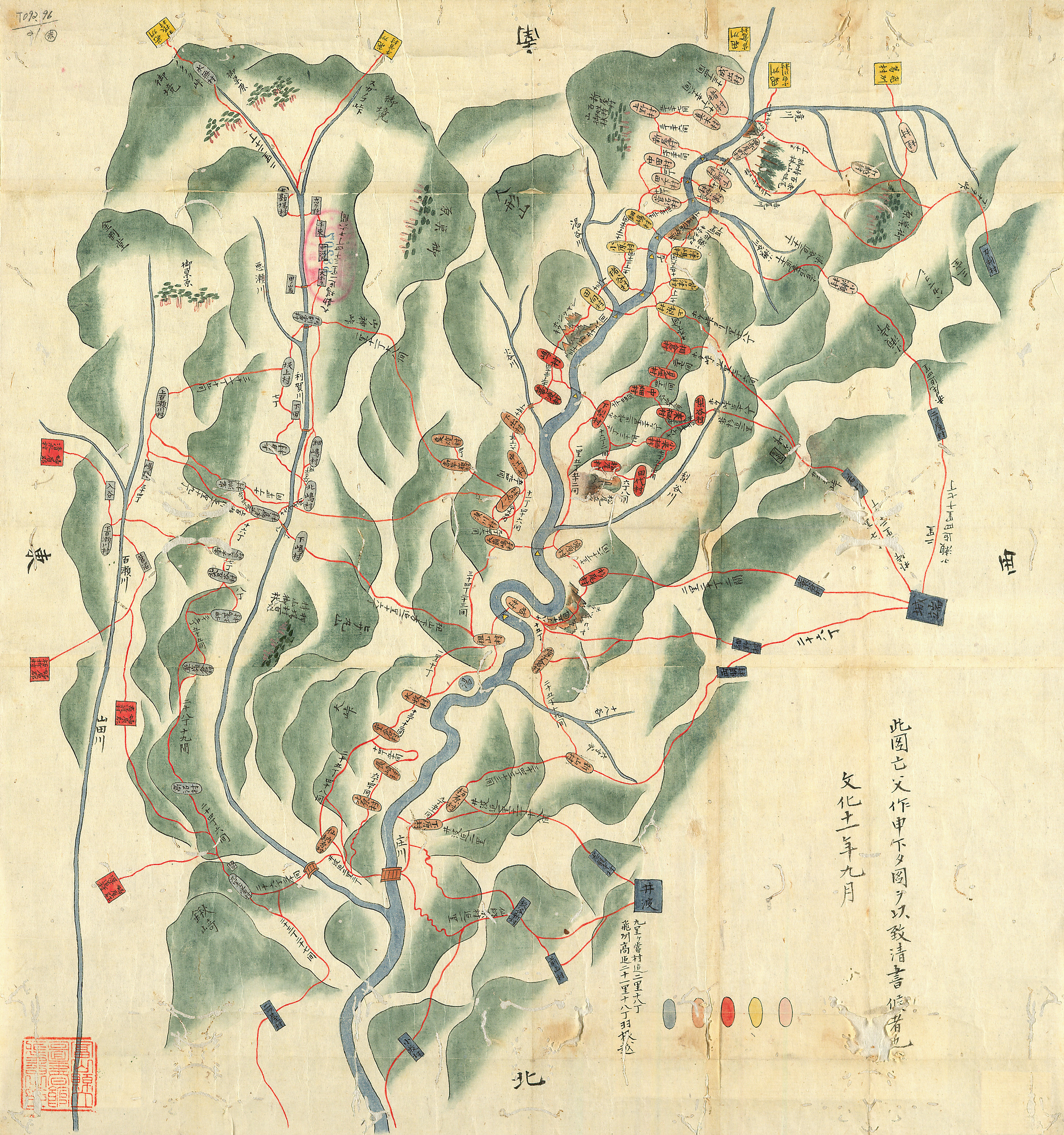
Map of Etchu Gokayama (1814) – Collection of Toyama Prefectural Library
A detailed map from the Kaga domain period, showing the villages of Gokayama, the routes connecting them, and the roads leading to Johana and Inami. Ten ferry crossings along the Sho River are marked with symbols, and hazardous riverbank sections are also noted. The villages of Ainokura and Suganuma are indicated along the main course of the Sho River.
Industries that Sustained Life in Harsh Mountain Environments
In Shirakawa-go and the Gokayama region, the limited flat land in these mountainous areas meant that rice cultivation was scarce. Only small fields and slash-and-burn plots produced crops such as millet, chestnuts, and buckwheat, allowing little more than subsistence-level farming. As a result, livelihoods making use of mountain resources developed early on. The main products were sericulture using mountain mulberry trees, niter production from mountain plants (used as a raw material for black gunpowder), and handmade paper from mulberry bark. Timber, firewood, lacquer, and other forest products were also harvested. Among these, sericulture directly influenced the development of the distinctive gassho style houses and flourished especially from the late Edo period through the Meiji era.
Sericulture
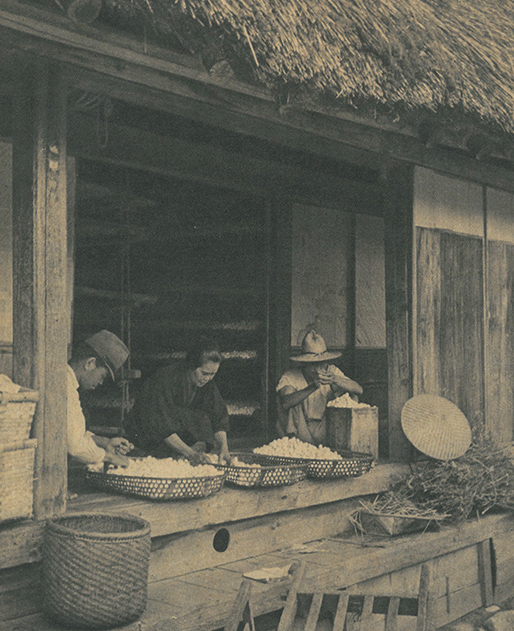
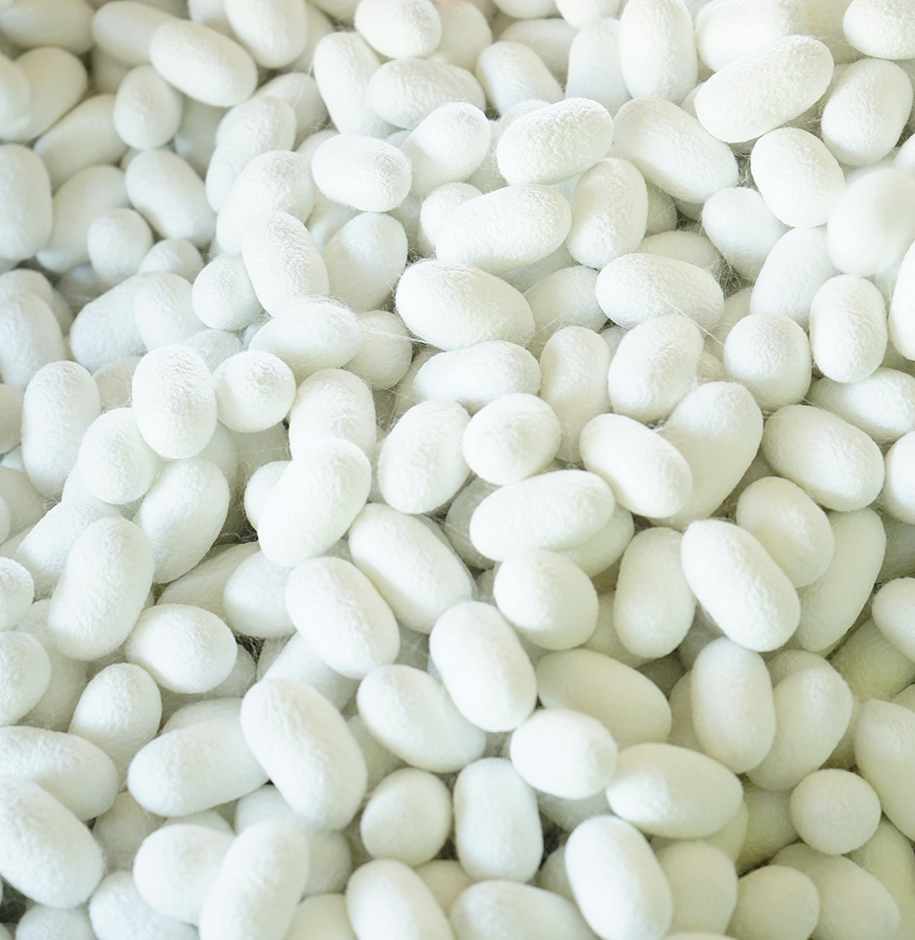
The raising of silkworms and reeling of raw silk from cocoons was already recorded in Shirakawa-go and Gokayama in the early 16th century, but it became widespread around the late 17th century. In Gokayama, records show that silk thread was offered to Hongan-ji during the Tenbun era (1532–) and that Maeda Toshiie received a tribute of silk thread equivalent to 3 kan 300 me in 1585. These documents (property of Sugawamura) reveal the long-standing importance of silk production in the area. The development of sericulture in Shirakawa-go, in particular, was strongly influenced by the rise of the silk-weaving industry in Johana, Etchu Province, which began in the Tensho era (1573–). Throughout the Edo period, production remained steady, and from the late Edo period, with the increase in silk and textile exports through foreign trade, sericulture in Shirakawa-go and Gokayama rapidly expanded to become their most important industry.
According to the Record of Silk Tax Collection kept at the Shirakawa-guchi checkpoint office on the Kaga domain border, nearly 90% of the raw silk shipped from Shirakawa-go to Etchu in 1837 was carried out by merchants from Johana. This shows that Johana merchants actively crossed into Shirakawa-go to purchase raw silk, and that Shirakawa-go and Gokayama supported the silk-weaving industry of Johana as suppliers of high-quality cocoons and raw silk.
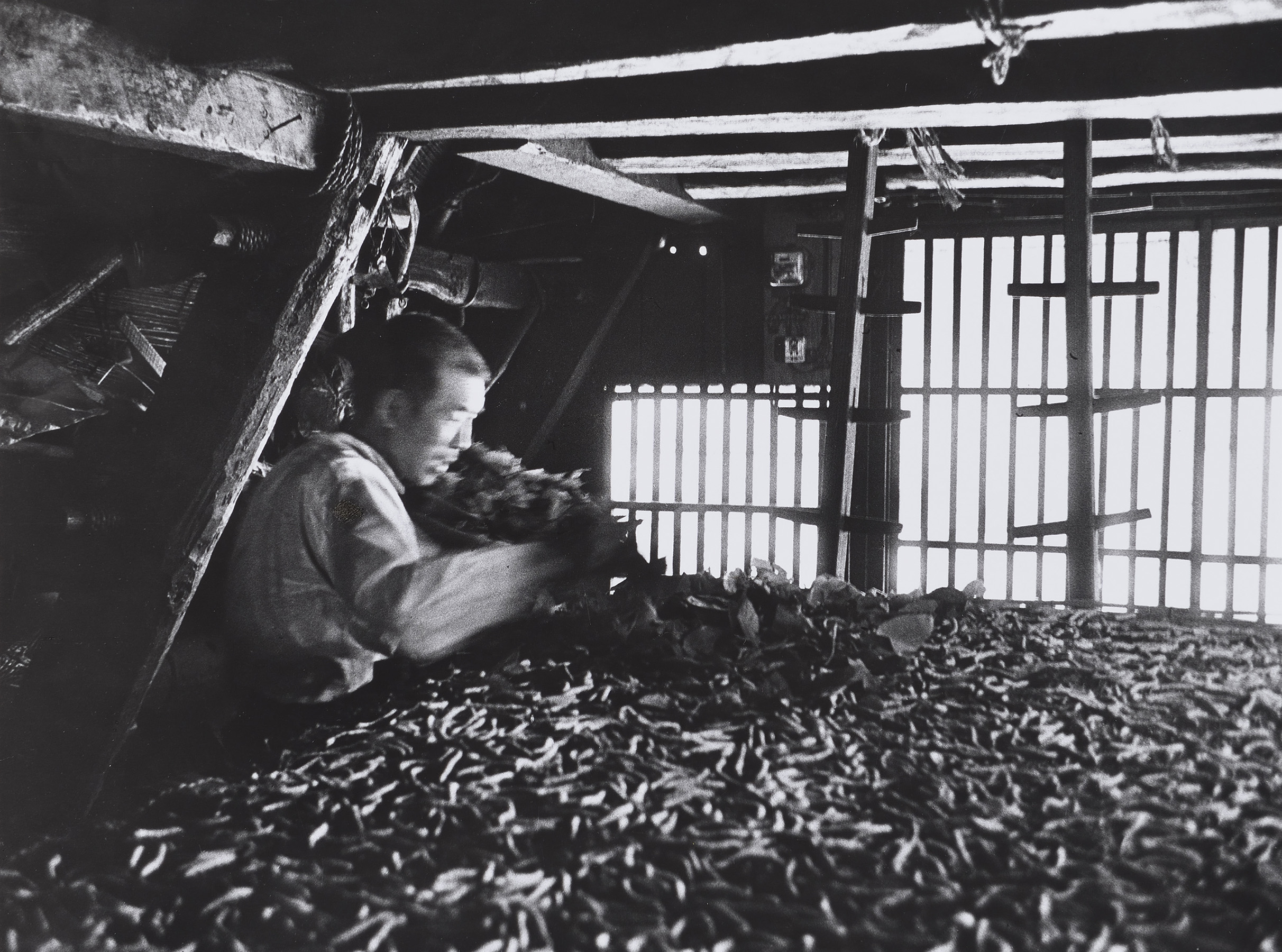
Photo: Koyo Hosoe (Collection of Gifu Prefectural Museum of Art)
―― One of Hida’s Leading Producers of Cocoons
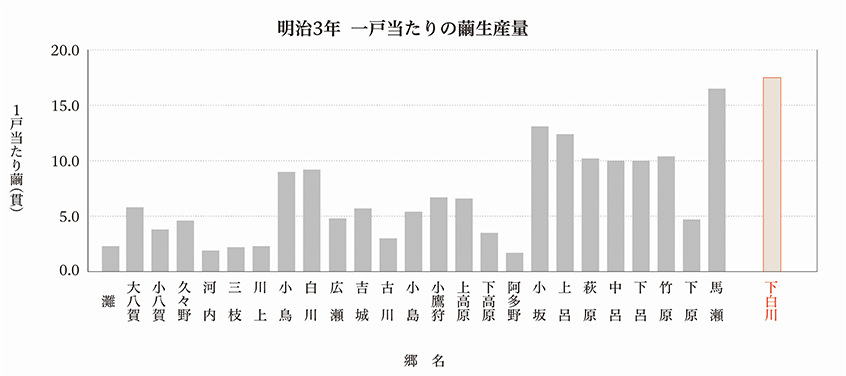
By the late Edo period, sericulture was practiced in nearly every village in Hida. The Hida Gofudoki compiled in 1870 records cocoon production by village, and the results show that the villages with the highest per-household production were concentrated in seven villages of Mashita-gun, excluding Atano and Shimohara. What is particularly noteworthy is Shirakawa-go's production. The average cocoon yield for all of Shirakawa-go at the time was 9.5 kan, but this figure includes Shokawa, where sericulture was not yet well developed. Limiting the figures to Shimoshirakawa-go, which is the area of today’s Shirakawa Village, the average rises to 17.5 kan—an outstanding figure. This shows that Shirakawa Village boasted the highest per-household cocoon production in all of Hida at the time.
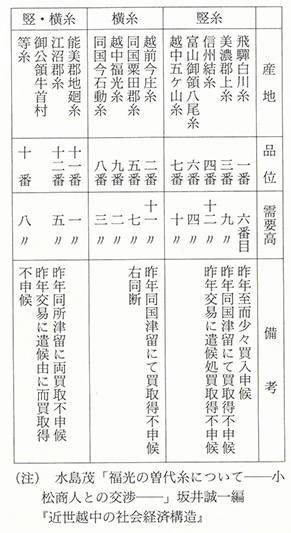
As for raw silk production, in the early Meiji period silk-reeling factories appeared in Hida, concentrating production in specific towns such as Takayama, Furukawa, and Funatsu. By contrast, in Shirakawa-go, raw silk production remained largely in the form of home-based reeling by farming households. Among all of Hida, only a few areas exceeded 300 kan of raw silk: Takayama Town (2,463 kan), followed by Furukawa Town (378 kan) and Funatsu Town (342 kan). Shirakawa-go, however, produced 510 kan, rivaling Furukawa and Funatsu. In other words, this made Shirakawa-go the most active center of home-based silk reeling in Hida. The silk of Shirakawa-go was also renowned for its quality. A memorandum (1861) by silk merchants from Komatsu, once a major center of Kaga silk weaving, states that Shirakawa silk from Hida was ranked at the very top grade for warp thread.
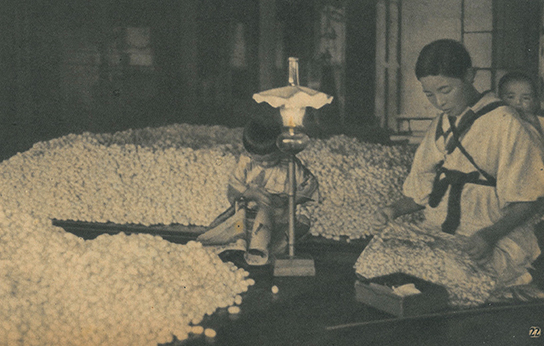
Photo: Spring cocoon harvest at the Wada family house in Ogimachi, Shirakawa-go (1940).
Per-household cocoon production in 1870
Quality Ranking of Komatsu Silk by Production Area
Shirakawa Silk from Hida Ranked at the Highest Grade
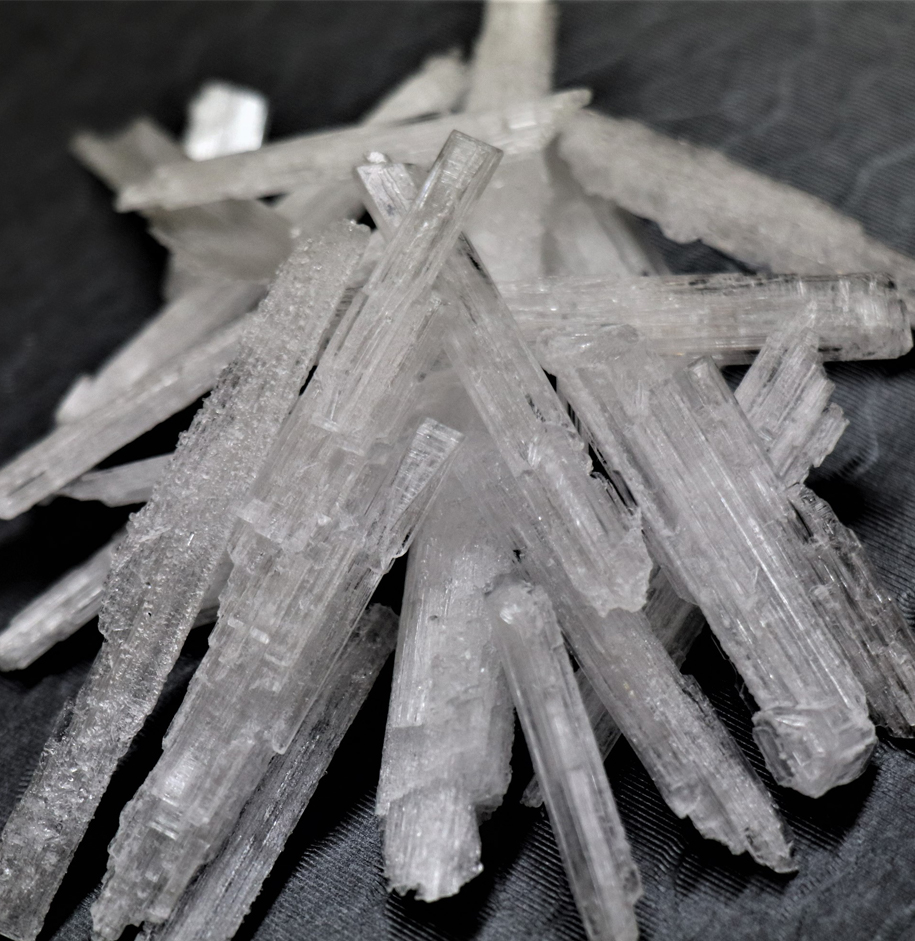
Saltpeter Crystals
Saltpeter
Saltpeter was the raw material for black gunpowder and thus an essential military commodity. For this reason, its production was strictly controlled and specially protected: in Shirakawa-go by the Takayama Magistrate’s Office (Takayama Jinya), and in Gokayama by the Kaga domain. The origins of saltpeter production go back further in Gokayama. It is recorded that during the Ishiyama War of 1570, when Oda Nobunaga fought Hongan-ji, saltpeter from Gokayama was transported to the Hongan-ji temple fortress. Considering that this was less than 30 years after the introduction of firearms to Japan, it shows that the region was producing saltpeter at a very early stage. Production later spread to Shirakawa-go, and in time both areas became centers of the craft.
Saltpeter was made by digging pits under gassho style houses, filling them with soil, grass, and silkworm droppings, and allowing nitrifying bacteria to generate nitrate compounds. These nitrates were then leached out with water, boiled down, and crystallized into crude saltpeter (ash-boiled saltpeter). Wealthier farmers known as joniya purchased the crude saltpeter, refined it into high-grade saltpeter, and shipped it to the Kaga domain and to Edo through local wholesale networks. Documents related to this saltpeter trade remain in both Shirakawa-go and Gokayama.
Because refining and extraction were carried out in winter, saltpeter production fit well with the climate and lifestyle of the region, just as handmade paper-making did. Since nitrate compounds are highly soluble in water, deep pits had to be dug into the ground beneath houses. This required spacious floor areas, and is said to have been a major factor behind the development of the large-scale gassho style houses.
Saltpeter production, which required much labor under the floors of gassho style houses, flourished for centuries. However, with the import of cheap Chilean saltpeter in the Meiji period, official purchasing came to an end, and production ceased.
―― From Soil Preparation to Ash-Boiled Saltpeter Production
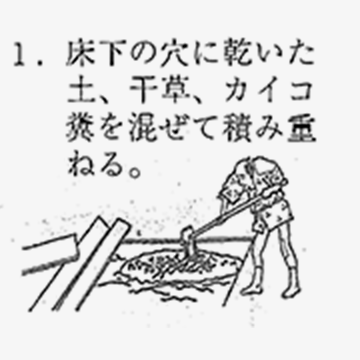
Mix dry soil, hay, and silkworm droppings, and pile them into pits beneath the floor.
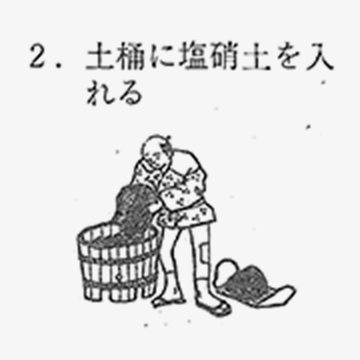
Place the nitrate-rich soil into wooden tubs.
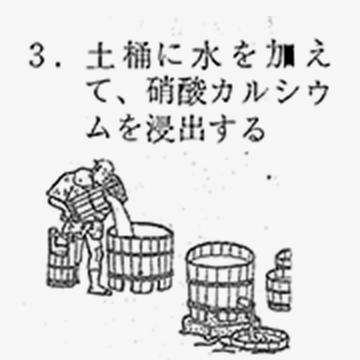
Add water to the tubs to leach out calcium nitrate.
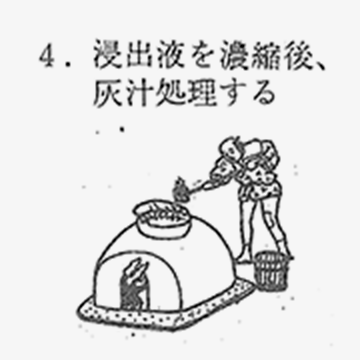
Concentrate the leachate, then treat it with lye.
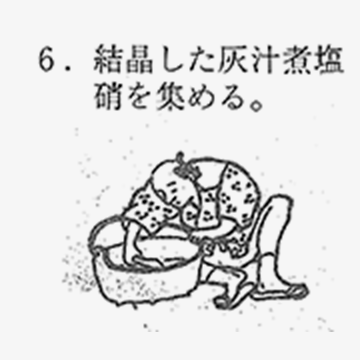
Collect the crystallized ash-boiled saltpeter.
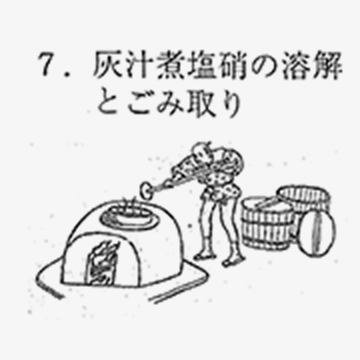
Dissolve the ash-boiled saltpeter in water and remove impurities.
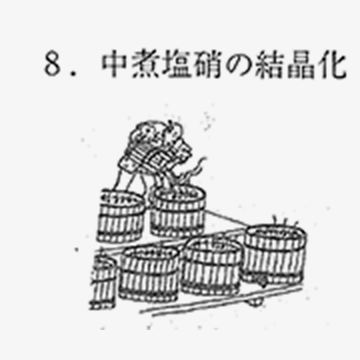
Crystallize into intermediate-grade saltpeter.
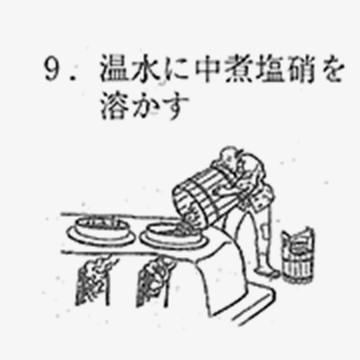
Dissolve the intermediate saltpeter in hot water.
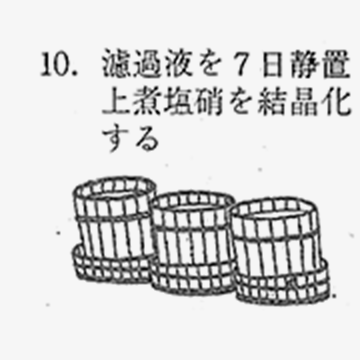
Let the filtered solution stand for seven days to crystallize into refined saltpeter (upper-grade saltpeter).
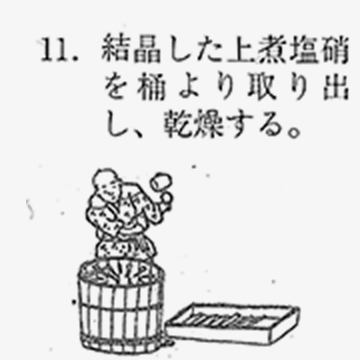
Remove the crystallized refined saltpeter from the tubs and dry it.
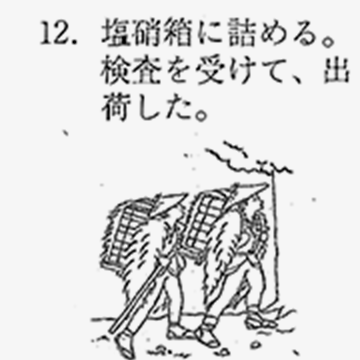
Pack the refined saltpeter into boxes, undergo inspection, and ship it.
―― Gokayama Saltpeter and the Kaga Domain
Gokayama came under the rule of the Maeda clan in 1585. From 1605, it was required to deliver 2,000 kin of saltpeter annually as tribute in kind. During the feudal administration, Gokayama was classified as “14 groups of Tonami, 2 groups of Gokayama,” set apart from the lowland areas of Tonami District. Governance was tailored to the natural and social conditions of Gokayama. Unlike the plains, where tribute was paid mainly in kind, Gokayama was excluded from the cadastral survey of 1605 and from that year on was assessed tribute in cash. As a distinctive taxation system for this mountainous area, where farmland was scarce, saltpeter itself was designated as a taxable commodity. A directive issued in August 1605 by Maeda Toshinaga to the Gokayama overseer specified for the first time that saltpeter was to be incorporated into the tax system. Later, in 1637, the 2,000 kin of saltpeter was converted into eight kinsu of gold currency, after which it was known as the “saltpeter levy” and paid in cash. Throughout the Edo period, Gokayama saltpeter was prioritized for delivery to the Kaga domain, but surplus amounts were also sold to merchants in Kyoto and Osaka. By the late Edo period, with foreign naval powers increasingly appearing off Japan’s coasts, the domain required larger reserves of gunpowder. In 1848, in addition to purchasing the regular quota of 114 batches of refined saltpeter, it also began buying intermediate-grade saltpeter, leading to a sudden surge in demand. In 1858, the domain issued new “production expansion regulations” to increase output by 290 batches. At that time, Gokayama had more than 1,300 households, of which only 113 were not engaged in saltpeter-making. Even those were encouraged to participate in the ash-boiling process, and virtually every household became involved in production. Thus, under both the protection and strict control of the Kaga domain, Gokayama continued to sustain its saltpeter needs.
Delivery of Saltpeter from Gokayama, Etchu Province, 1615
Total: 2,000 kin — as per prior arrangement
All duly received
1616, Toshimitsu
14th day of the 4th month, with seal
Gokayama, Ichinosuke
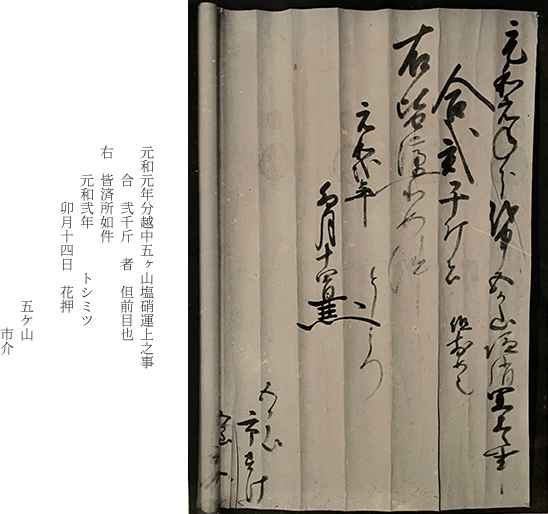
The levy of 2,000 kin of saltpeter continued until it was revised in 1636. This document is a receipt issued in 1615 by Maeda Toshitsune, the third lord of Kaga, acknowledging delivery from Ichinosuke.
―― The Kaminiya Guild of Gokayama
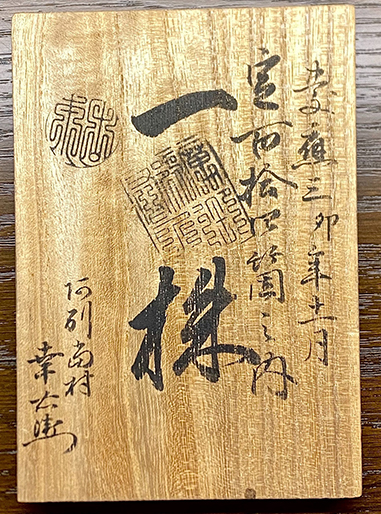
Guild Shares for Upper-Grade Saltpeter Refiners
One share entitled its holder to produce one batch of official saltpeter, weighing 40 kin (24 kg). Thus, the total number of shares corresponded exactly to the total amount of official saltpeter. There were 105 shares until 1748, then 94 shares until 1784, and afterward 114 shares.
Saltpeter was refined in three stages by boiling and crystallization: ash-boiled, intermediate, and upper-grade. The earliest stage, ash-boiling, was carried out almost everywhere: official reports from 1764 and 1821 both state that “in all of Gokayama, except for Shiro and Kurigato villages, ash-boiling is performed.” This means that nearly all 70 villages of Gokayama were involved, and large numbers of farming households participated.
By contrast, upper-grade refiners were limited to a smaller number of powerful “prosperous farmers.” Only such well-to-do villagers could afford the necessary funds to purchase crude saltpeter, invest in refining facilities, and secure labor. They also needed to negotiate with the Kaga domain over pricing, advance payments, official sealing of the saltpeter, its transport, shipment outside the domain, and official buybacks. For this reason, upper-grade refiners banded together early on, forming an organized guild known as a kabu-nakama (shareholding association).
An upper-grade share was essentially a right to produce official saltpeter for the domain. Each share authorized its holder to produce one 40 kin batch (24 kg) of official saltpeter.
―― The Gokayama Upper-Grade Refiner Fujii Choemon and Shirakawa-go
Saltpeter production in Shirakawa-go is believed to have begun before the Genroku era (1688–1704). In the early period, crude saltpeter from Shirakawa-go was reportedly purchased and refined by Fujii Choemon of Nishiakao, Gokayama. As one of the leading suppliers of official saltpeter to the Kaga domain, Choemon employed many workers year-round in sericulture, saltpeter refining, and papermaking. The Kaga domain loaned rice to the Fujii family interest-free, which they in turn lent to small farmers. Collecting both interest on the rice loans and profit from saltpeter, the Fujii family is said to have amassed great wealth.
Initially, Shirakawa-go’s saltpeter was likely delivered to the domain through Choemon’s distribution route. Through his saltpeter refining operations, Choemon’s economic power eventually extended into Shirakawa-go. By the late early modern period, a branch of the Fujii family, the Fujii Tobee household—descended from Choemon—moved into Hatogaya Village in Shirakawa-go, becoming one of the area’s most prominent landholders and village headmen. It is thought that their settlement in Shirakawa-go was made possible by land investments financed through the great fortune accumulated by Choemon’s family.
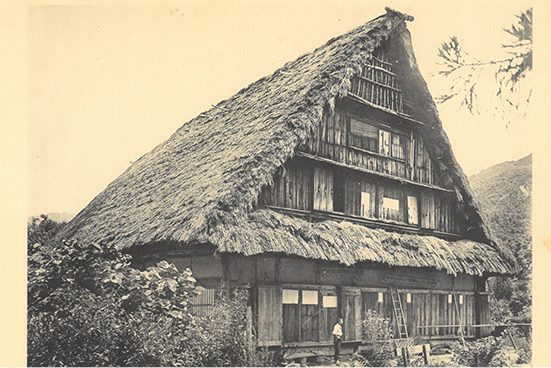
The Fujii Tobee Residence, Which Expanded into Shirakawa-go in the Late Early Modern Period (1930)
The Fujii family preserved a construction plan dated 1788, indicating that this gassho style house in Hatogaya, Shirakawa-go, was built at that time. The plan shows a beam span of 22.2 meters, making it one of the largest gassho style houses of its era.
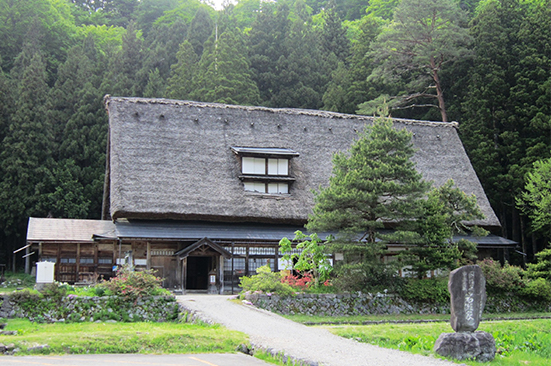
Important Cultural Property: The Iwase Residence (Former Fujii Choemon Residence)
Built over a period of eight years in late Edo times in Akao, Gokayama, this house is among the largest surviving gassho style houses. Today it is owned by the Iwase family and designated as an Important Cultural Property.
―― The Wada Family, an Upper-Grade Refiner of Shirakawa-go, and the Takayama Magistrate’s Office
The Wada family was a prominent household in Ogimachi Village, Shirakawa-go, serving as village headmen in the late early modern period. From 1790 until the Meiji Restoration, they also staffed the Ushikubi checkpoint guardhouse. Since Shirakawa-go was direct shogunate territory, they maintained close ties with the Takayama Magistrate’s Office, the seat of the Hida district governor. The Wada family was recognized as an upper-grade refiner with the right to refine and sell saltpeter. Among their preserved records are the “Memorandum of Saltpeter Refining Accounts” (1814) and wooden licenses issued by the Takayama Magistrate confirming their authorization to sell saltpeter.
The memorandum mentioned above notes the existence of four saltpeter barrels dated as early as 1689, suggesting that saltpeter production in Shirakawa-go was already taking place by then. Accordingly, the origins of saltpeter production in Shirakawa-go are considered to date back to before 1689. Documents preserved by the Wada family detail saltpeter transactions from 1813 to 1865. Sales distribution during this period was as follows: Kaga domain: 53.2%, Mino: 20.4%, Osaka Castle administrators: 13.8%, Takayama: 8.9%, and Owari domain: 3.7% Over half of the trade was with the Kaga domain, reflecting Shirakawa-go’s border location and the fact that Gokayama alone could not meet the Kaga domain’s saltpeter needs. Shirakawa-go thus played a complementary role.
In Shirakawa-go, unlike in Gokayama, saltpeter production could be taxed but shows no evidence of having been incorporated into the villages’ regular tribute. This indicates that control over saltpeter production by the Takayama Magistrate’s Office was looser than that of the Kaga domain, and, as seen in the distribution of sales above, producers were allowed to ship their goods freely up until the end of the Edo period.
After Perry’s arrival at Uraga in June 1853, shogunal defense policies grew urgent, and the shogunate began purchasing saltpeter directly. The Takayama office appointed Iijima Kihei of Takayama as the procurement agent, and that year it surveyed all inventories of upper-grade refiners in Hida. More than 70% of the stock was held by three Shirakawa-go refiners (Isuke, Shirobei, and Yayemon), showing that Shirakawa-go had become the central hub of saltpeter production in Hida at the time.
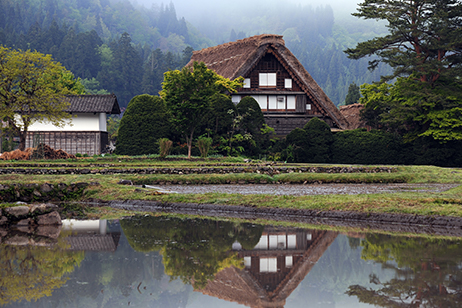
Important Cultural Property: Wada Residence
Built in the mid-19th century, this was one of the largest gassho style houses in Shirakawa-go and the home of the village headmen.
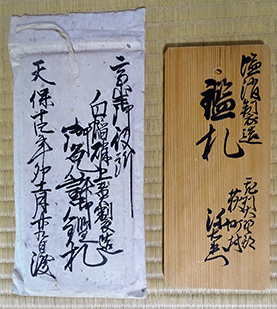
A wooden license issued by the Takayama Magistrate to Yayemon (of the Wada family), granting the right to sell saltpeter.
(1843)
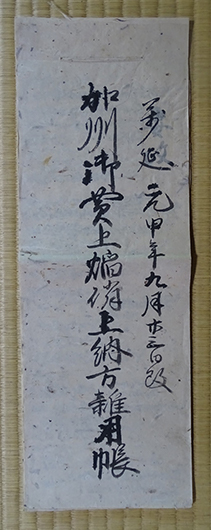
The “Miscellaneous Accounts of Saltpeter Deliveries Purchased by the Kaga Domain” (1860).
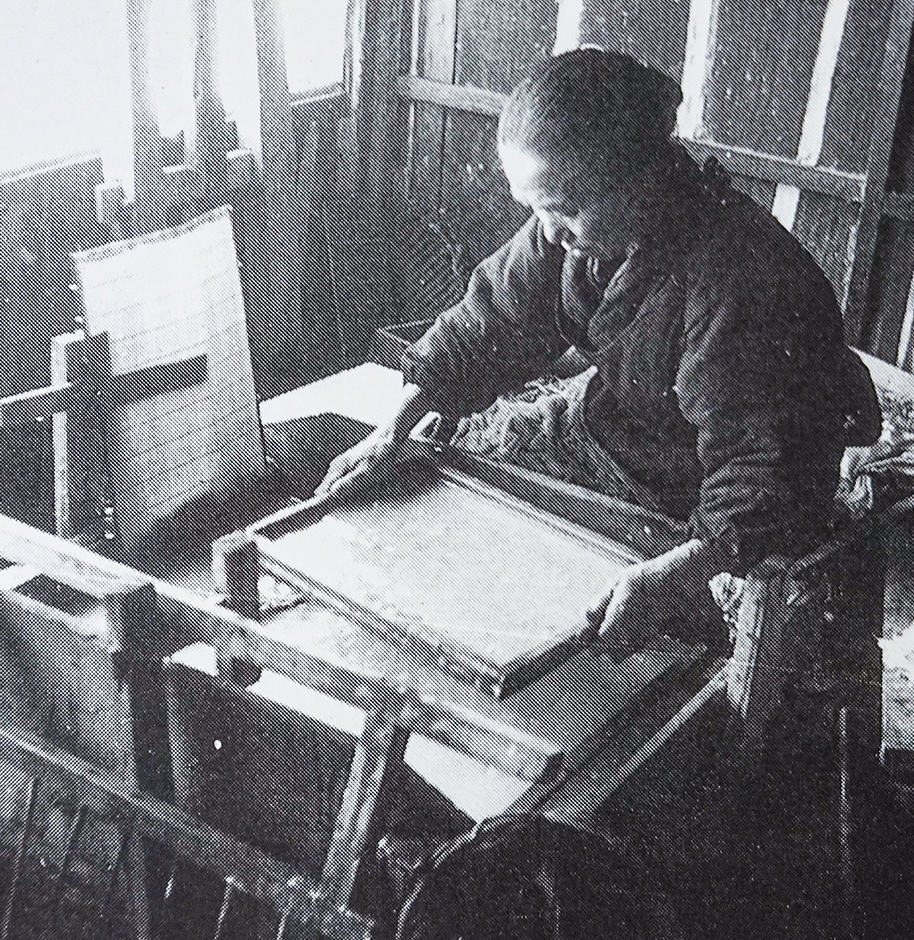
Washi Paper
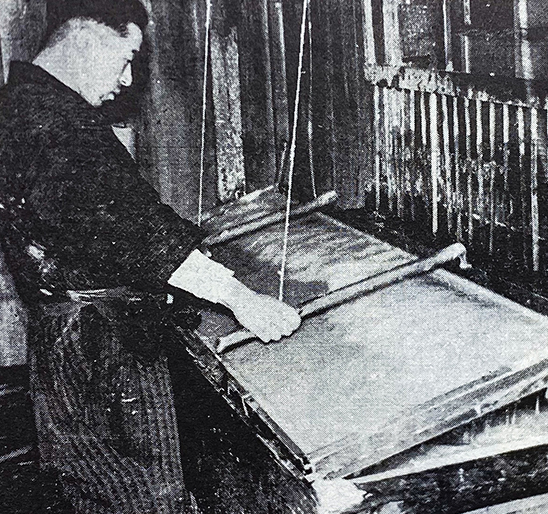
In Shirakawa-go and Gokayama, sericulture and saltpeter production were the main industries, while papermaking was practiced in winter as an off-season agricultural sideline. In Gokayama in particular, paper—like silk and saltpeter—could be sold to cover the annual tribute payments owed to the domain, and thus paper was also subject to tribute levies. As a result, Gokayama became the more advanced center of papermaking, while Shirakawa-go mainly produced mulberry, the raw material for paper, and sold it to Gokayama.
The exact origins of papermaking in Gokayama are unclear, but records show that paper was presented to the Kaga domain in 1615, in the early Edo period. Over time, Gokayama papermaking developed as an official domain industry. Papermakers in Gokayama were divided into three categories: ordinary papermakers, officially designated papermakers, and imperial-supply papermakers. The officially designated papermakers produced paper under strict domain supervision, while the imperial-supply papermakers produced most of the domain’s official paper. These privileged papermakers enjoyed special rights, including assistance with tool repairs, access to timber for paper molds, and loans of rice. A registry titled “List of Papermakers in Both Gokayama Groups” (1785) records six such papermakers: designated papermakers Kaemon and Jiemon of Shimonashi Village, Shinemon of Miza Village, imperial-supply papermakers Taroemon and Sukekuro of Minami Miza Village, and Ichibe of Kaminashi Village.
The raw material for Gokayama paper, mulberry bark, came mainly from Tonami District, including Gokayama itself. When supplies ran short, mulberry was also purchased from within the domain, such as from Niikawa District, as well as from Shirakawa-go and the provinces of Noshu and Echizen. In Shirakawa-go, mulberry cultivation expanded in response to this demand from Gokayama. Records show that within Shirakawa-go, mulberry production was concentrated in the Ogo area (Iijima Village) and the Yamake area, which bordered Gokayama. These villages accounted for about 80% of total production, while in the southern Nakagiri area mulberry cultivation was virtually nonexistent. When mulberry was transported to Etchu, a levy was imposed at the checkpoint, and as a result, records of mulberry shipments into Gokayama have been preserved to this day.
After the Meiji Restoration, with the abolition of the domain’s production office, the privileges of papermaking households were abolished, raising concerns about the industry’s survival. However, the functions previously overseen by the domain were taken over by private organizations, allowing Gokayama papermakers to continue under similar conditions as before. In 1950, the Gokayama Paper Cooperative Association was formed, followed in 1968 by the Higashinakae Washi Production Cooperative. Even as traditional washi production declined across Japan, classical papermaking techniques were preserved in Gokayama. In 1988, Gokayama paper, together with washi from Yatsuo and Asahi Towns in Toyama Prefecture, was designated a National Traditional Craft under the name “Etchu Washi.” Today, the papermaking culture of Gokayama continues to live on.